


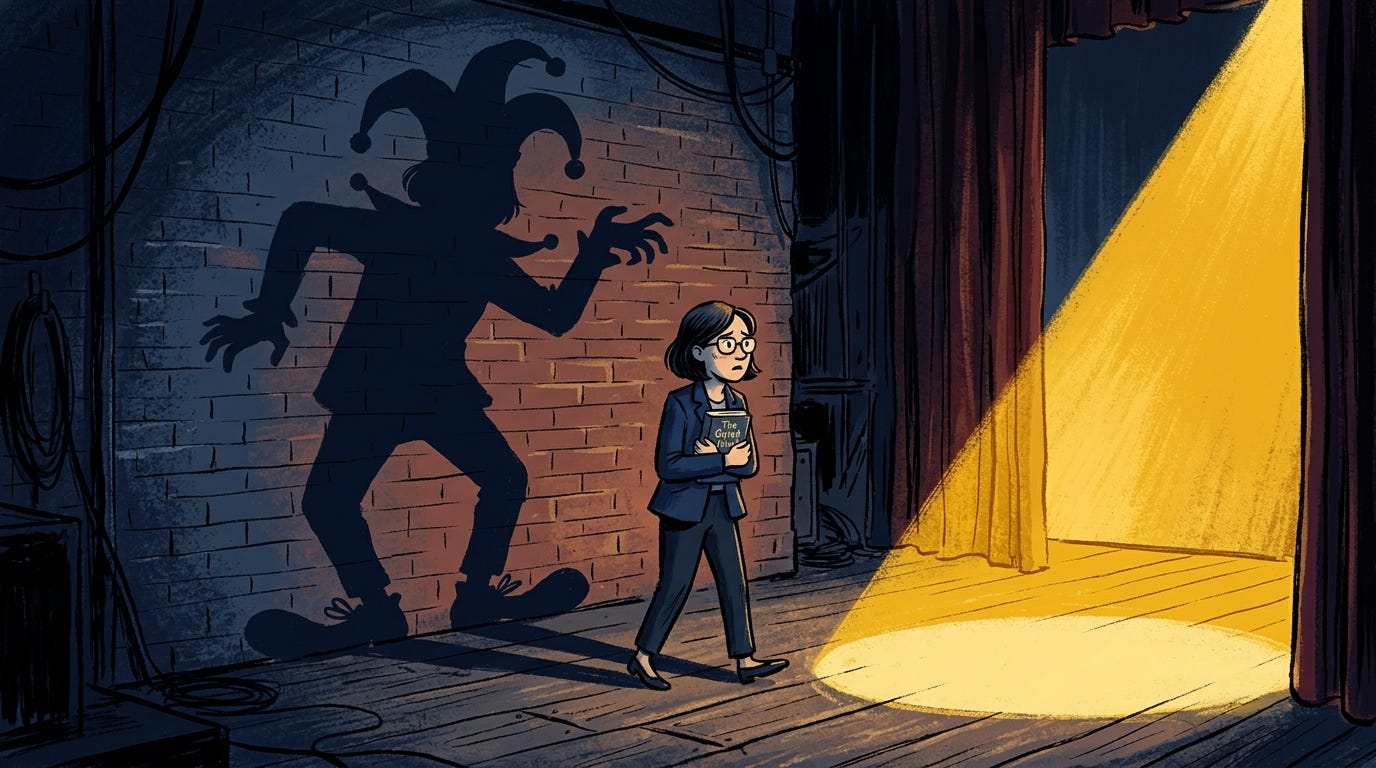
I used to think that hitting the bestseller list would be the cure. I imagined a specific moment – maybe an email from Amazon or a certain royalty threshold – where the internal critic would finally pack its bags and leave.
I was wrong.
It turns out that for independent authors, success doesn’t quiet the “fraud” voice. It gives it a megaphone.
The Success Paradox
There is a cruel irony in the creative life. The better you do, the more you feel like you’re pulling off a heist. Psychologists call this the Success Paradox.
When you’re starting out, you can blame failure on lack of experience. But when you succeed? Your brain looks at the data and says, “That was a fluke. The market was quiet. People were just being nice. And now, they expect me to do it again.”
You aren’t alone in this. Even the heavyweights are terrified.
Sandra Brown has sold millions of books. She’s a household name. Yet, she still deals with the fear that “this time everyone will find out.” David Morrell, the man who created Rambo, looks at his own prose from the day before and thinks it’s “terrible.”
If people with fifty-year careers and global franchises still feel like they’re blagging it, why do we expect ourselves to feel “legitimate”?
Why Indie Authors Have it Harder
In traditional publishing, you have a gatekeeper. An agent or an editor says “Yes,” which gives you a tiny shield of external validation.
As an indie, you have to give yourself permission.
Without that institutional stamp of approval, it’s easy to slip into the “Valley of Despair.” You move from the “Peak of Enthusiasm” (where you don’t know enough to be scared) to a place where you finally understand how hard the craft actually is. That drop in confidence isn’t a sign that you’re getting worse – it’s proof that your taste is improving.
Practical Ways to Fight Back
If external wins won’t fix it, internal shifts have to. Here is how to keep the work moving when the critic gets loud:
1. Keep a “Praise Folder”
Your brain is a biased historian. It remembers every one-star review and forgets the thousands of five-star ones. Counteract this by saving screenshots of reader emails and positive milestones in a dedicated folder. When you feel like a fraud, look at the evidence. Facts over feelings.
2. Focus on Process, Not Outcome
You can’t control the Amazon algorithm. You can’t control how a reviewer feels on a Tuesday. You can control your word count. Tether your sense of success to the daily habit. If you wrote 500 words today, you won. Period.
3. Name the Voice
Externalize the critic. It isn’t you talking; it’s a “shadow protector” trying to keep you safe from the vulnerability of being seen. Call it something else. When it tells you the draft is trash, acknowledge it: “Thanks for the input, but I have work to do.”
4. Lean into the Community
Isolation is fuel for impostor syndrome. When you share your doubts with other writers, the “veil of keeping up appearances” drops. You’ll find that the author you admire most is likely staring at their screen right now, wondering if they’ve forgotten how to write a sentence.
The Bottom Line
Impostor syndrome isn’t a bug; it’s a feature of a high-growth career. It’s the physiological response to stepping out of your comfort zone.
True frauds don’t worry about being frauds. They don’t care about the craft enough to doubt themselves. The very fact that you’re worried about being “good enough” is the best evidence we have that you actually belong here.
Keep writing. Even if you have to do it while feeling like a fake.
Very helpful and to the point. I am fairly new to writing and constantly feel like I shouldn’t be here. I have a business as a blacksmith and write fiction with the hopes of selling my creations someday. The two worlds simply don’t seem they would mix. I am sure others feel like their JOB (whatever it is) feeds the imposter syndrome effect when compared to what they envision as the writer’s lifestyle.
I appreciate these reads! I feel less like the only imposter, if I am one.
"You can’t control the Amazon algorithm. You can’t control how a reviewer feels on a Tuesday. You CAN control your word count. Tether your sense of success to the daily habit. If you wrote 500 words today, you won. Period."
Excellent!-- what every reader needs to hear and take to heart. 👍