


You’ve finally done it. You set up your first Facebook Ad campaign. The creative is gorgeous, the hook is snappy, and the clicks are rolling in cheap. You feel like a marketing genius.
But a week later, you check your KDP dashboard and see… crickets. Or worse, your organic rank for “Cozy Mystery” has actually dropped.
Welcome to the Indie Author’s Traffic Paradox. In your quest to send more people to your Amazon book page, you might accidentally be telling Amazon that your book is irrelevant.
Here is the straightforward guide on how to fix this using a Bridge Page, based on the latest understanding of the Amazon A10 algorithm.
The “Invisible” Problem: Why Direct Links Can Be Dangerous
In traditional marketing, we are taught to remove friction. “Fewer clicks equals more sales,” right?
On your own website, yes. On Amazon, no.
Amazon’s search algorithm (often called A10) cares about one metric above all others: Revenue Per Search Query. In plain English, it looks at your Unit Session Percentage (conversion rate).
Scenario A (Direct Link): You send 1,000 people from TikTok directly to your book page. They are just curious. 995 of them bounce immediately. Only 5 buy.
Result: A 0.5% conversion rate. Amazon thinks, “Wow, people hate this book. Let’s stop showing it in search results.”
Scenario B (Bridge Page): You send those 1,000 people to a simple landing page first. 600 leave (the “bounce”). 400 click the “Buy on Amazon” button. 5 buy.
Result: Amazon only sees the 400 who arrived. That’s a 1.25% conversion rate — more than double the quality signal.
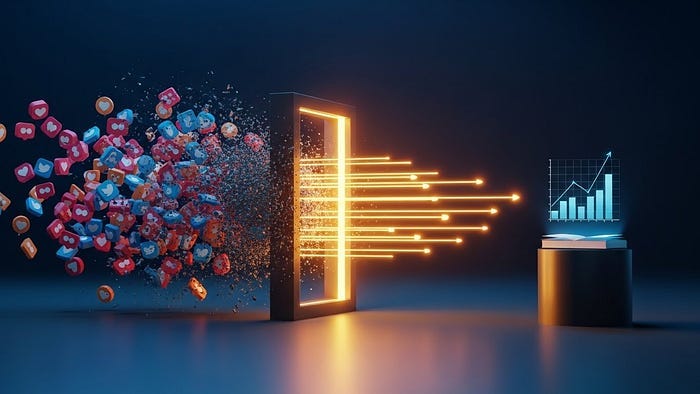
The takeaway: A bridge page acts as a bouncer at a club. It stops the “window shoppers” from getting inside and ruining the vibe (and your metrics) for the paying customers.
The “When”: The Simple Decision Matrix
You don’t always need a bridge page. In fact, sometimes they hurt your sales by adding unnecessary steps for people who are already ready to buy.
Here is the cheat sheet for 2025:
✅ USE A BRIDGE PAGE IF:
You are running Facebook/Instagram/TikTok Ads: This is “interruption marketing.” People are scrolling for dopamine, not shopping. You need to qualify them first.
You want to build your email list: Use the bridge page to offer a free chapter or a prequel in exchange for an email, rather than just pushing for a sale immediately.
You sell wide (Kobo, Apple, B&N): A bridge page lets you offer universal links so readers can choose their preferred store.
❌ DIRECT LINK (SKIP THE BRIDGE) IF:
You are sending a Newsletter: Your subscribers already know and like you. They are “warm” traffic. Don’t annoy them with an extra click.
You are using BookBub or Promo Sites: People on BookBub are there specifically to buy cheap books. They have high intent. Let them through the gates!
You are running Amazon PPC Ads: These users are already on Amazon searching for books. You can’t use a bridge page here anyway, but it’s worth noting the distinction.
3 Reasons Why the “Bridge” is Better for Your Wallet
It’s not just about protecting your ranking. It’s about making more money.
The Brand Referral Bonus (BRB): Did you know Amazon pays you a ~10% bonus on sales you drive from external traffic? It’s much easier to set up clean Attribution tags on a bridge page button than on every single ad variation you run.
Asset Ownership: If you direct link, Amazon gets the customer data. If you bridge page, you can place a retargeting pixel or capture an email. You are building your business, not just Jeff Bezos’s.
Global Routing: If a UK reader clicks your US Amazon link, they might see a “Currently Unavailable” message. A smart bridge page (using tools like Genius Link) automatically routes them to the correct Amazon store for their country.
How to Build One (The “Lightweight” Way)
You don’t need a degree in web design. A high-converting book bridge page needs exactly four things:
The Hero Image: A 3D mockup of your book cover.
The Hook: A one-sentence headline that grabs attention.
Social Proof: One or two short reviews (e.g., “Couldn’t put it down!”).
The Big Button: A clear CTA like “Get it on Amazon” or “Read for Free in KU”.
Tools to use:
BookFunnel: The gold standard for indie authors.
Carrd: Great for simple, one-page sites.
Genius Link: Offers “Choice Pages” that are automatically created for your books.
Final Thought
In 2025, the game isn’t just about traffic volume; it’s about traffic quality.
Don’t be afraid of the “drop-off” (people leaving your bridge page). Those people weren’t going to buy your book anyway; they were just going to wreck your conversion rate. Let the bridge page do the heavy lifting so your Amazon ranking can stay safe.