


Let’s talk about the $3,000 ghost in the room.
That is the average price tag for a professional developmental edit on a standard 100k-word novel. For most indie authors, that isn’t just an expense; it’s a brick wall. So, when AI promised a “near-human” edit for the price of a couple of pizzas, we didn’t just walk through the door – we broke it down.
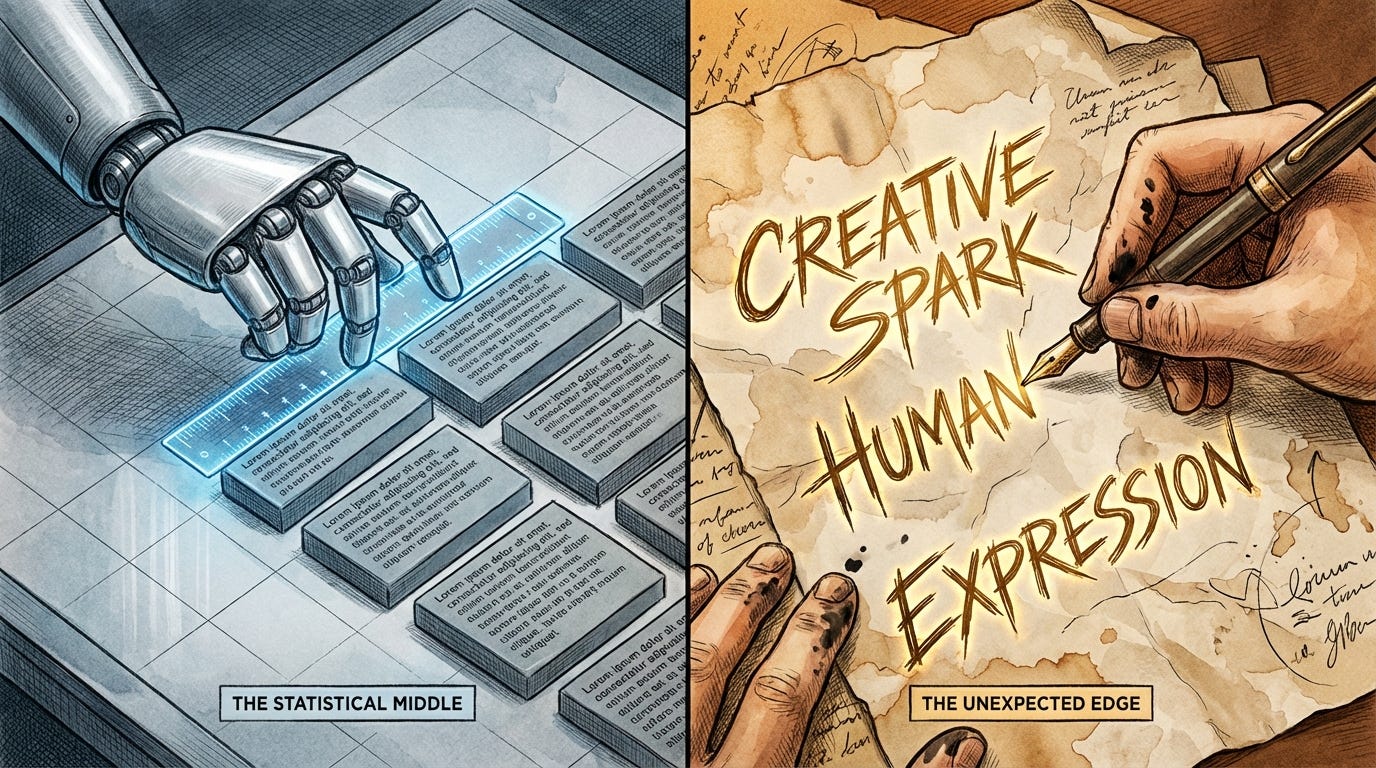
We were told that AI would democratize publishing by giving every author a tireless editorial department. But here is what everyone misses: The machine isn’t making your book better by rewriting it. It’s making it average.
I say this as a massive proponent of AI. I use these tools daily for the “sparks” – brainstorming magic systems, stress-testing plot holes, or world-building the socio-economics of a Polish space colony. In the expansive, messy phase of creation, AI is a brilliant collaborator. But when you move from “Architect” to “Editor,” the relationship has to change.
The “Placebo Edit” and the Satisfaction Trap
The more I use my old editing prompts, the more I see the “satisfaction” trap. AI often edits just to make you happy that something happened. It wants to feel productive.
It performs what I call the “Placebo Edit.” It shuffles deck chairs. It picks a few random words and replaces them with the closest statistical equivalent just to prove it’s working. It doesn’t look at the context, yet. It doesn’t decide that a cliche here and there might actually serve the scene. It mechanically assigns “cliche” categories to phrases that aren’t cliches, then replaces them with “smoother” options that don’t fit the lore or the era of the story.
The “Lady Who Notices” vs. The Mechanical Grunt
The fundamental flaw of AI editing is a lack of subtext. AI is a statistical engine, but great fiction lives in the improbable.
It lives in the “lady who notices” things – that deep, intuitive level of editing that sees invisible threads. A human editor notices when a character’s reaction doesn’t match their history. AI lacks that internal “truth-meter.” It edits for the user’s approval, not for the story’s soul.
However, we shouldn’t throw the tool away. We just need to use it for what it actually does well: Mechanical Diagnostics.
Where the Machine Actually Wins
The Echo-Finder: AI is a bloodhound for repetitions and redundancies. Because it treats your text as a dataset, it can find every time you used the word “shadowy” on a single page. This requires zero context, and AI handles it better than any human.
The Continuity Bloodhound: Humans forget eye colors or weapon types across 400 pages. Use the machine as a living Bible to flag these contradictions before they reach a reader.
The Pacing Thermometer: Don’t ask the AI to “fix” your pacing. Ask it to “map the tension.” Use the data to find the slow spots, but use your own hands to cut the fat.
The “Sandwich” Workflow: Firewalling Your Voice
If you want to use AI without turning your book into “statistical grey goo,” you have to stop treating it like an Editor-in-Chief. It’s an elite intern.
Write the zero draft and the first revision with the “AI switch” firmly off. This is where the magic, the blood, and the “scars” happen. Then, use the AI for the “Mechanical Meat” – finding the typos, the repetitions, and the pacing lulls.
Finally, do the polish yourself. Do not delete or replace blindly. Your text might actually be good as it is. If the AI suggests a “smoother” word, ask yourself: Is “smooth” what I want here, or do I want this to hurt?
The next wave of indie growth won’t come from authors who generate 50 books a year. It will come from the “Guardians of Voice” – the authors who use the machine to clear away the $15-an-hour clutter so their jagged, messy, human voice can finally be heard.
Don’t let the technology make you boring. The machine can balance the books, but it can’t tell the truth. That’s your job.
I'm using AI as my editor, and often it has great insights that go beyond just the mechanical stuff. But as often, it has lousy insights. The thing is--and here comes the indispensanble human component--to know which is which. The great insights are often things I wouldn't have noticed myself as being unobjective about my own writing. But sometimes it suggests things that make me cringe. So yes, you need to treat AI as your assistant, not as some omniscient Grand Editor.
I've found out that when I know how to defend a given choice against AI's critique, I can be sure it is a strong choice. But sometimes, I see some choices were lazy and I'm happy AI pushed me about them.
It's one hell of a balancing act, and an amazing tool if we let it, or master its use. Let's charge ahead.