


After the Pangram piece went out, a reader left a long comment, and then muted me. I’ve read it four times now, and it is the best argument against my position that anyone has made, which is awkward, because it also happens to prove the thing I was worried about.
Her case, compressed: the who matters. You look at the diplomas on a doctor’s wall before you take his advice, and a Rothko sells for eighty-five million because of whose hand held the brush, not because coloured rectangles are hard to make. Readers want to know who is behind the words, and if a writer says he uses AI in his workflow, some of them will pass. Detectors, she wrote, are all that readers have, and running someone’s sample chapter through one is a small piece of power in a market that took a lot of power away from them this year.
I agree with one half of that. Readers are owed the information, and anyone who wants to skip me over it should skip me, since being skipped knowingly beats having someone feel tricked three books later. The other half, that the who is what makes the work worth reading, is where I think she is wrong, and I’ll come back to it.
Here, though, is the part I can’t get past. She never ran my article through a detector, because she didn’t need to. I told her, in print, unprompted.
And the detector she is defending is the one from the article she was replying to, the same tool that stamped 100% on prose nobody could flag by reading it. Her empowerment, then, runs on an instrument she has no way to check. There is no appeal, no error bar, and no account, however thin, of what the machine actually saw. She trusts the score because the alternative is trusting writers, and writers have given her plenty of reason not to.
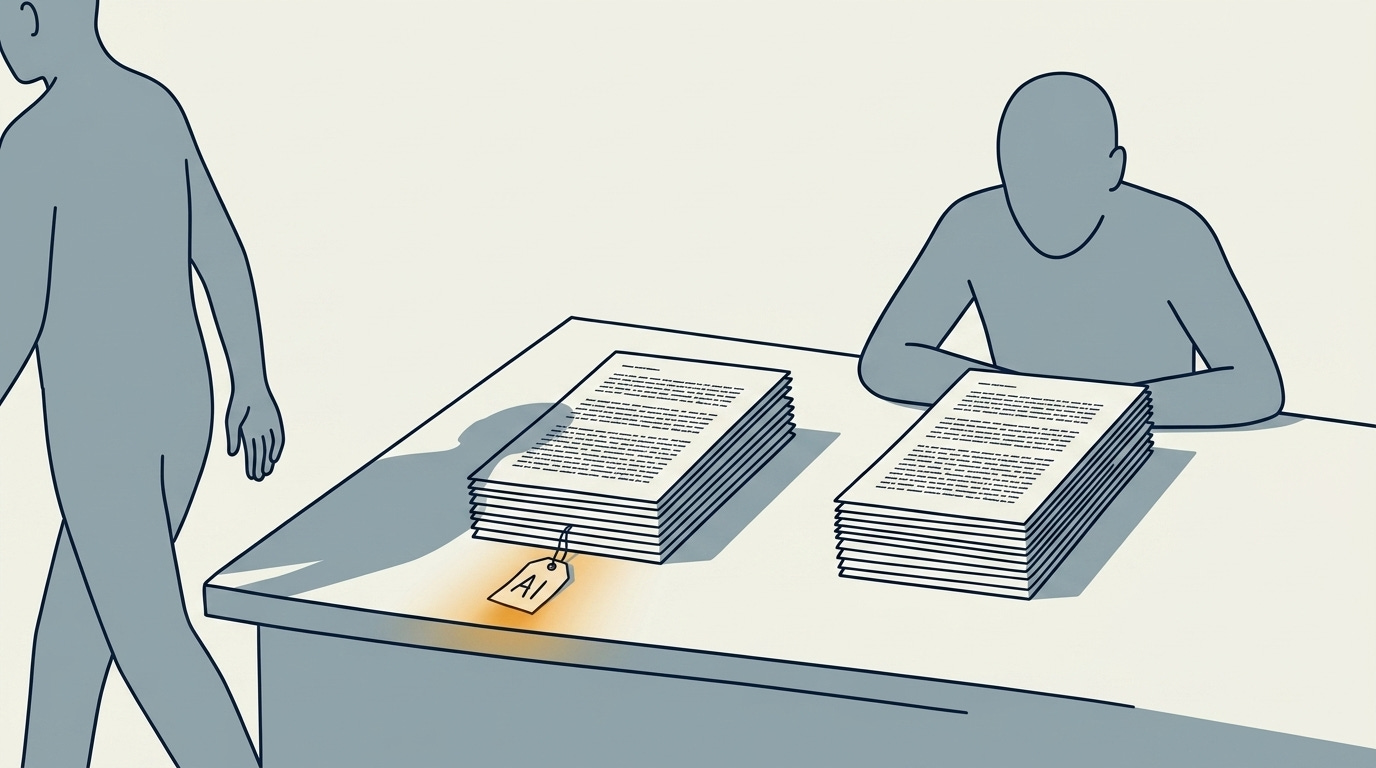
So look at what actually happened, in order. I disclosed, she read the disclosure, she left, and nothing about the sentences on the page changed between the moment she liked the work and the moment she didn’t.
That is the incentive structure, and it’s brutal in a boring, procedural way. Stay quiet and you are clean until an algorithm says otherwise, and if it ever does, you get to be loudly outraged about false positives, with the numbers on your side. Say something and you have handed over the evidence yourself, permanently, with no false-positive defence available to you. The only voluntary signal in the whole system, a writer telling you what he did, is the one that gets punished hardest.
Run that forward a year and ask which writers are still disclosing. Not the ones who watched what it cost, I think. The norm eats itself, and what is left is a market where everyone is silent and everyone is scanning, and the scanners are wrong at a rate that nobody publishes.
I keep coming back to the diplomas, because I don’t think that is how any of us actually choose a doctor. Standing in a waiting room reading the frames on the wall is not something I have ever done. I ask around, find out who my friends were happy with, then go to the one people say is good, and no doctor has ever been crossed off my list for training in Karachi instead of Boston. The wall of paper is decoration; the reputation is the real instrument, and it is built out of hundreds of people reporting what happened to them afterwards.
Books work the same way, only more so. Nobody has ever bought a novel because of the author’s credentials, and if the diploma test applied to fiction, most of the shelf would be empty.
The Rothko is a worse example than she thinks, because she chose the one market where price and merit came apart decades ago. Nobody pays eighty-five million for the pleasure of looking at coloured rectangles. They pay for a name, a provenance chain, a tax position, and a thing to hang where visitors will see it, and the proof is that an identical canvas by an unknown hand is worth a few hundred euros and the same canvas relabelled as a Rothko is worth a fortune. There are painters alive right now, better than most of what hangs in the auction houses, selling nothing, because the market that trades on the who is not looking at the work at all. That is the argument for judging the object in front of you, not the argument against it.
Which is the same trade she is making with my article, in miniature. Her filter is not “is this any good,” it’s “was a machine anywhere near it,” and those two questions come apart the moment you apply them, since she would take a worse post written by hand over a better one written with help and count that as a win. She is buying the label. So is the collector.
The honest version of her position isn’t “detectors give readers power.” It’s closer to this: I don’t want to read AI-assisted work, I have no reliable way to identify it, so I will act on the confessions I get and take everything else on faith. That’s coherent, and I understand it, but it produces a world where the writers who tell the truth are the only ones anybody ever filters.
This is where she and I part company for real, and I’ll say it plainly instead of faking a doubt I don’t have. If I read a book and it moves me, I do not care how it was made. No one has yet explained to me the mechanism by which a paragraph I loved on Tuesday becomes worse on Wednesday when I learn which tools were open on the writer’s desk. The words did not change. What changed is a story I am now telling myself about the person, and I would rather have the book.
What I know is that I am now slightly worse off for having written the sentence “I use AI in my workflow,” that I will write it again anyway, and that I cannot recommend anyone else do the same with a straight face. Show me a version of this where disclosure buys a writer something, anything, and I will switch sides that afternoon. Nobody has yet.
If people knew celebrity chefs wenty actually at their own restaurants cooking the food, would the guest like the food less because there's a team of trained cooks on the line? Some like this lady might, but she's living a conditional life where purity means more than outcome. Her future choices will be extremely limited.