


A few months ago I published my KDP Dashboard Autopsy Prompt.
The idea was to take my KDP exports, give them to an AI model, and ask it to look at the business without trying to make me feel good about it. Where does the money actually come from? Which books still have momentum? Where does a series lose readers? Am I spending money on books that stopped earning it back months ago?
I still like the prompt. But I ran an updated version on my own data recently and realized there was something fairly important missing.
Not another formula. Context.
KDP can tell me what happened. It is much worse at telling me what I was doing when it happened. That matters more than I thought.
I can look back and see that KENP jumped in a particular month. Fine. Why?
Was I running a promotion? Did I increase Amazon Ads? Did I send a newsletter? Was that when I changed the cover? Did a reviewer or BookTuber mention the book? Was there a sequel launch around the same time? Did I drop the price for a few days?
Maybe I remember if it happened last month. Six months later? Good luck.
And if I don’t remember, the AI doesn’t know either.
It can still give me an answer, of course. That is part of the problem. Give a model a sales spike and enough surrounding data and it can usually come up with a very reasonable explanation for it.
Reasonable does not mean true. I ran into a version of this while testing the new Autopsy Prompt.
One result showed that Kindle Unlimited represented a very large percentage of my recent Amazon royalties for a specific series. On paper, it looked like a strong argument against leaving KDP Select. Then I looked at the actual dollars.
The income for this series had fallen so much that KU could represent most of what was left while still earning me only a few dollars a day. The percentage was correct. The conclusion I initially drew from it wasn’t.
That was easy enough to fix in the prompt. Important percentages now need the actual dollar amount next to them, along with the recent trend. But that sent me down a different path.
What else am I asking the model to work out from incomplete information?
Quite a lot, apparently.
Suppose I changed a cover in March, spent $250 on a promotion in April, switched off Amazon Ads in May because they were going nowhere, and delayed the next book by six weeks in June. All of that could matter when I look at the sales curve later.
None of it is going to be obvious from a KDP export.
Yes, I could probably reconstruct most of it. Amazon Ads has the campaign history. Meta has the spend. MailerLite knows when I sent emails. There are old covers somewhere in Canva. My calendar probably has launch dates.
But am I really going to dig through five different systems six months from now because I want to understand why sales dipped for three weeks in June?
Probably not.
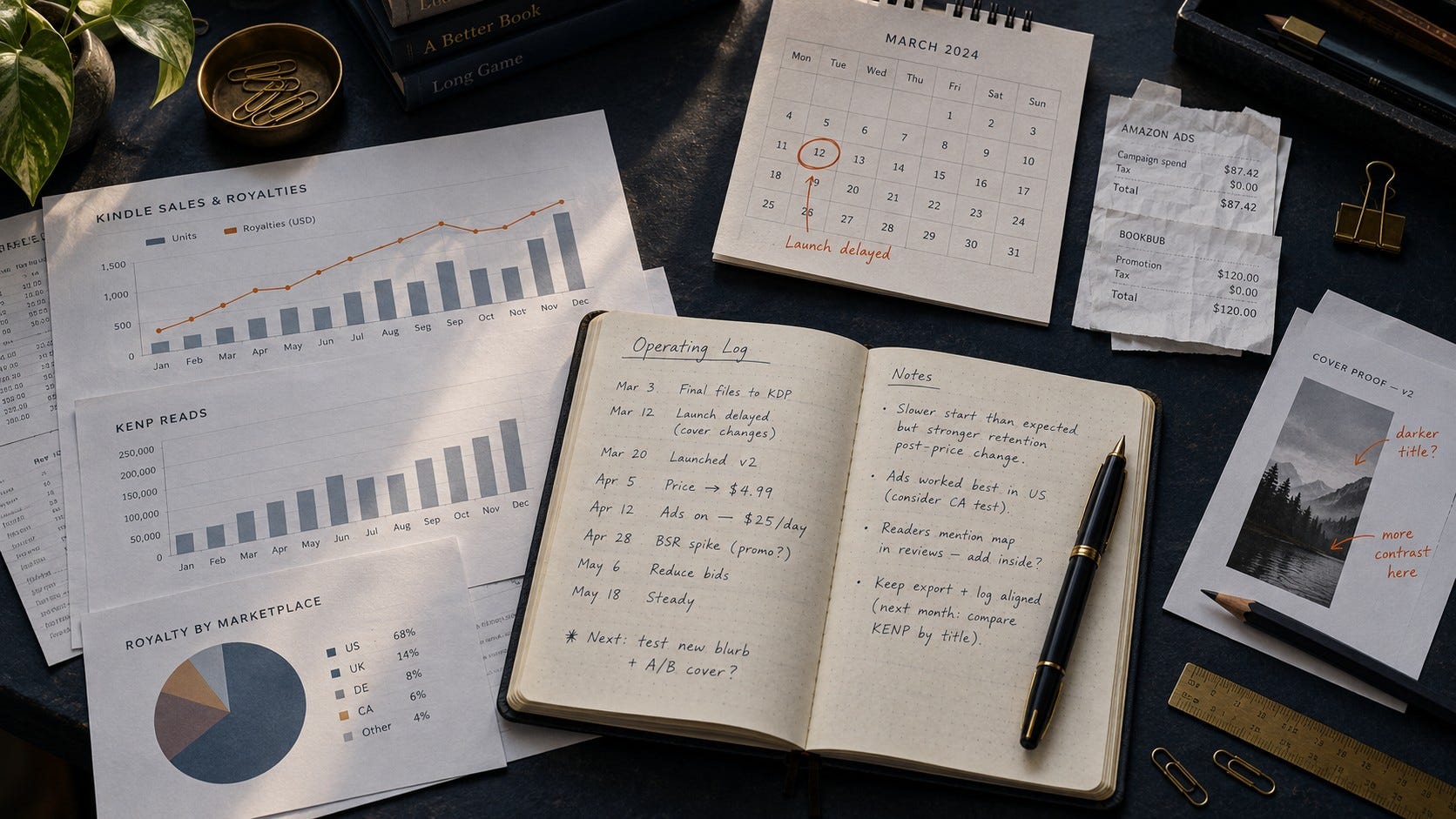
So I think the answer is much simpler. I need to keep a publishing log. Not some giant spreadsheet with 47 columns that turns into another job. Just a short record of anything that might matter later.
Once a week, write down what changed.
How much did I spend on ads and where?
Which book was I pushing?
Did I run a promo?
Change the price?
Send a newsletter?
Launch something?
Delay something?
Change a cover or blurb?
Pause a campaign?
Leave KU?
Add another retailer?
Get featured somewhere?
Have some random KDP problem that seemed annoying but temporary?
Most weeks the entry might be three lines. That’s fine. What matters is that six months later I can look at a weird movement in the data and have something better than, “I think maybe I did a promo around then.”
I would probably keep each entry to five things:
Date. What changed. Which book or series. Money involved. Why I did it.
For anything that is actually an experiment, I would also write down what I expected to happen. Something like:
“Started $10/day Meta campaign to Book 1. Not expecting the campaign itself to be profitable. I want to see whether acquiring more Book 1 readers works once series read-through is included.”
That is the kind of note I wish I had for a lot of things I’ve tried over the last year. Because when I come back later, I don’t just know that I spent money. I know what I was trying to achieve. Then I can compare the result with the original idea instead of inventing the strategy afterwards.
I’d probably do a slightly bigger note at the end of each month as well. Total ad spend by platform. Any launches or delays. Major promotions. Distribution changes. Anything unusual. Nothing fancy. The point is just to save the context while I still remember it.
That’s the thing historical publishing data loses. KDP will happily tell me how many pages were read on June 14. It won’t tell me that I switched an ad campaign off on June 10 because the CPC had gone stupid.
It might show a drop in Book 1 sales, but not that Book 2 was supposed to launch that month and didn’t.
It might show an old title suddenly waking up for a week, but not that somebody with a decent newsletter happened to mention it.
And this gets much more useful once AI enters the picture. If I give a model only the KDP exports, it can find patterns. If I give it the exports plus six months of notes about what I actually changed, it has something much closer to a business history.
It still can’t prove that the new cover caused the sales increase or that the newsletter caused the KENP spike. But at least it knows those things happened. It can compare dates, look for similar patterns elsewhere, and tell me where the evidence is strong and where I’m probably just seeing coincidence. That is much better than asking it to fill in the blanks.
So this is the part I missed with the first Autopsy Prompt.
I spent a lot of time thinking about how to make the AI analyze my publishing data better. I should also have been thinking about what information I need to preserve so there is actually something useful to analyze later.
I’m going to start keeping that log. Five minutes a week should do it.
Because KDP is very good at remembering how many books I sold. It has absolutely no idea what the hell I was doing at the time. And six months later, neither do I.