


The publishing industry used to be a set of neat, walled gardens. High Fantasy on one side. Romance on the other. A brass nameplate on each gate, and never the twain shall meet.
Then Sarah J. Maas showed up with a sledgehammer.
Millions of copies and billions of TikTok views later, we’re living in the era of the “Romantasy” juggernaut. You can call it a trend. It’s more accurate to call it psychological engineering with a cover artist on retainer.
The Romantasy Engine: High Stakes, Higher Heartbeats
In traditional epic fantasy, the romance is usually a side quest – a prize for surviving the plot. In the Maasverse, the romance is the plot.
In A Court of Thorns and Roses, Feyre Archeron doesn’t break a curse because she has a hero’s heart. She does it because she’s already in love, and Maas makes sure you feel that distinction somewhere behind your ribs. The emotional stakes and the physical stakes get welded together. Choosing a partner stops being a character beat and becomes a military alliance, a political calculation, a survival strategy.
That fusion creates the “one more chapter” compulsion. The reader can’t detach because the world-ending threat and the broken heart are the same wound.
The Rise of the “Alpha-hole”
Let’s talk about the men.
Rhysand. Rowan. Hunt. Ancient, lethal, emotionally wrecked. The “alpha-hole” archetype arrives brooding and often antagonistic, carrying centuries of damage like luggage nobody else is allowed to touch.
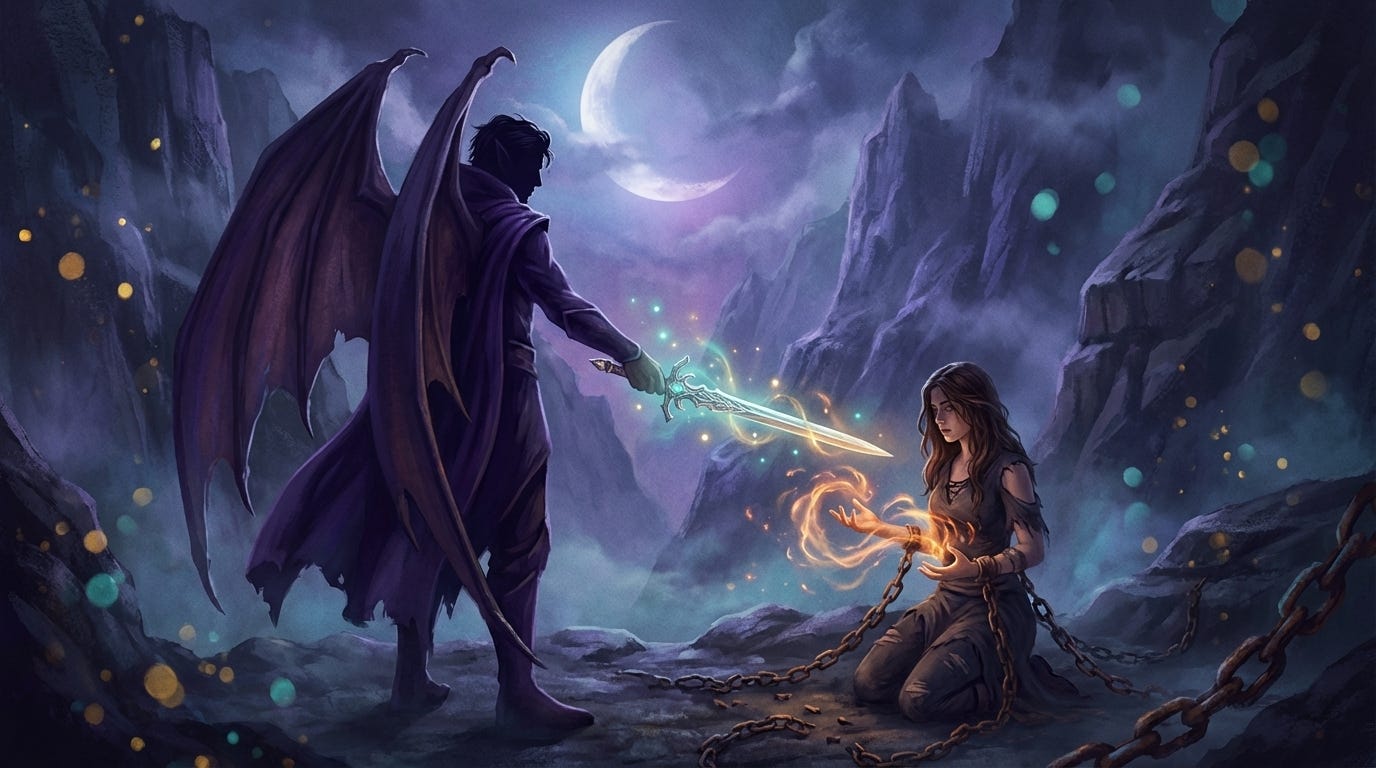
Here’s what Maas does that breaks the old playbook: these men don’t rescue anyone. The sword gets handed to the heroine with a “you know where to aim this.” The ancient, all-powerful love interest becomes her loudest advocate – not her ceiling.
It’s a precise inversion of the tired protector fantasy. The partner is a titan who treats her as a superior. That’s the appeal, stated plainly.
Healing Through Fire and Magic
Feyre, Aelin, Bryce – none of them start as Chosen Ones. They start as people crushed by specific, named suffering. Poverty that’s already eaten the furniture. A grief that hasn’t moved in two years and isn’t planning to.
Maas doesn’t fast-forward through recovery. The confrontation of internal damage is the plot engine. Magic systems tend to mirror this – power unlocks when the protagonist stops running from what broke her, not when she trains hard enough.
The repetitiveness critics complain about is, arguably, the point. Trauma doesn’t have a clean third act.
The Mid-Book Trap Door
Here’s the structural move that doesn’t get enough credit: the bait-and-switch.
A Court of Thorns and Roses builds a Beauty and the Beast love story with Tamlin. Then the sequel detonates it. The safe, beautiful romance curdles into something controlling. The apparent villain turns out to be the actual love interest. Everything the reader thought they were reading gets rewritten in the spine.
This isn’t just a plot twist. It’s a thematic argument that lands harder than most literary fiction manages – that relationships can look perfect and still be cages. Readers don’t just enjoy the reversal. They evangelize it. That’s the TikTok fuel, right there.
The “Found Family” Moat
Nobody fights alone in these books, and that’s a commercial decision as much as a narrative one.
The Inner Circle, the court of exiles, the pack of rogue supernaturals – they exist because Maas understood early that side characters are the stickiness. You read past book one to check in on Cassian, on Azriel, on whoever got a loaded glance in the last chapter. The world starts to feel lived-in. Familiar. Eventually it feels like somewhere you’ve actually been, which is a very specific and very profitable kind of loyalty.
Spin-offs become inevitable. The found family trope is, functionally, a reader-retention pipeline.
What Critics Keep Getting Wrong
“YA with spice” gets cited as a flaw in Maas’s prose. The accessibility is the mechanism.
She’s bridging two enormous markets: fantasy readers who’ve never felt an emotional pulse in the genre, and romance readers who’ve wanted an epic world with actual geography and consequence. The prose doesn’t need to be Nabokov. It needs to be frictionless. And there’s craft in that – the level of explicit content is staged across the series, escalating in proportion to how much these people have torn themselves open for each other. Intimacy as evidence, not decoration.
The Maas phenomenon is what happens when a writer correctly identifies that “epic” and “intimate” were never actually opposites – just kept in separate rooms by people with something to gain from the arrangement.