


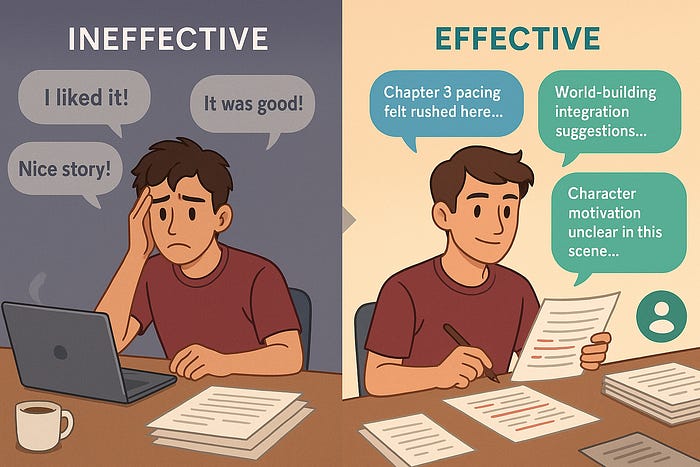
Stop getting “I liked it” responses and start getting the insights that will transform your manuscript
As an indie author, you’ve poured your heart into your manuscript. You’ve revised, polished, and perfected every sentence until you can recite passages from memory. But there’s one crucial step that separates published authors from those with forever-unfinished drafts: getting meaningful feedback from beta readers.
The problem? Most authors approach beta reading all wrong. They send their manuscript to friends and family, ask “What did you think?” and get responses like “It was good!” or “I really enjoyed it!” These well-meaning comments feel nice but do absolutely nothing to improve your book.
Here’s how to transform your beta reading process from a feel-good exercise into a manuscript-perfecting machine.
Understanding What Beta Readers Actually Do (Hint: It’s Not Editing)
Before you can get good feedback, you need to understand what beta readers are – and what they’re not.
Beta readers are not:
Editors who fix your grammar and sentence structure
Alpha readers who help you build the story from scratch
Cheerleaders who exist to boost your confidence
Beta readers are:
Your first real audience
Symptom reporters who tell you where your story breaks down
Test subjects who simulate how your target readers will experience your book
Think of beta readers as crash test dummies for your manuscript. Their job isn’t to tell you how to fix problems – it’s to show you where the crashes happen.
The Art of Asking: Why Your Questions Determine Your Results
The quality of feedback you receive is directly proportional to the quality of questions you ask. Sending a manuscript with “Let me know what you think!” is like going to a doctor and saying “I don’t feel good” without describing your symptoms.
Descriptive vs. Prescriptive Questions: The Game Changer
Bad (Prescriptive) Questions:
“Do you think I should add more world-building in Chapter 3?”
“Should the villain be more threatening?”
“Does the ending need to be longer?”
These questions presuppose problems and push readers into the role of co-author – a role they’re not equipped for.
Good (Descriptive) Questions:
“After reading Chapter 3, did you have a clear sense of the world and setting? Was there anything you were confused about?”
“How did you feel about the villain? Did they feel like a genuine threat to the protagonist?”
“What was your emotional state when you finished the book? Did the ending feel complete?”
Descriptive questions encourage readers to report their experience rather than solve your problems. They give you the “what” so you can figure out the “how.”
