


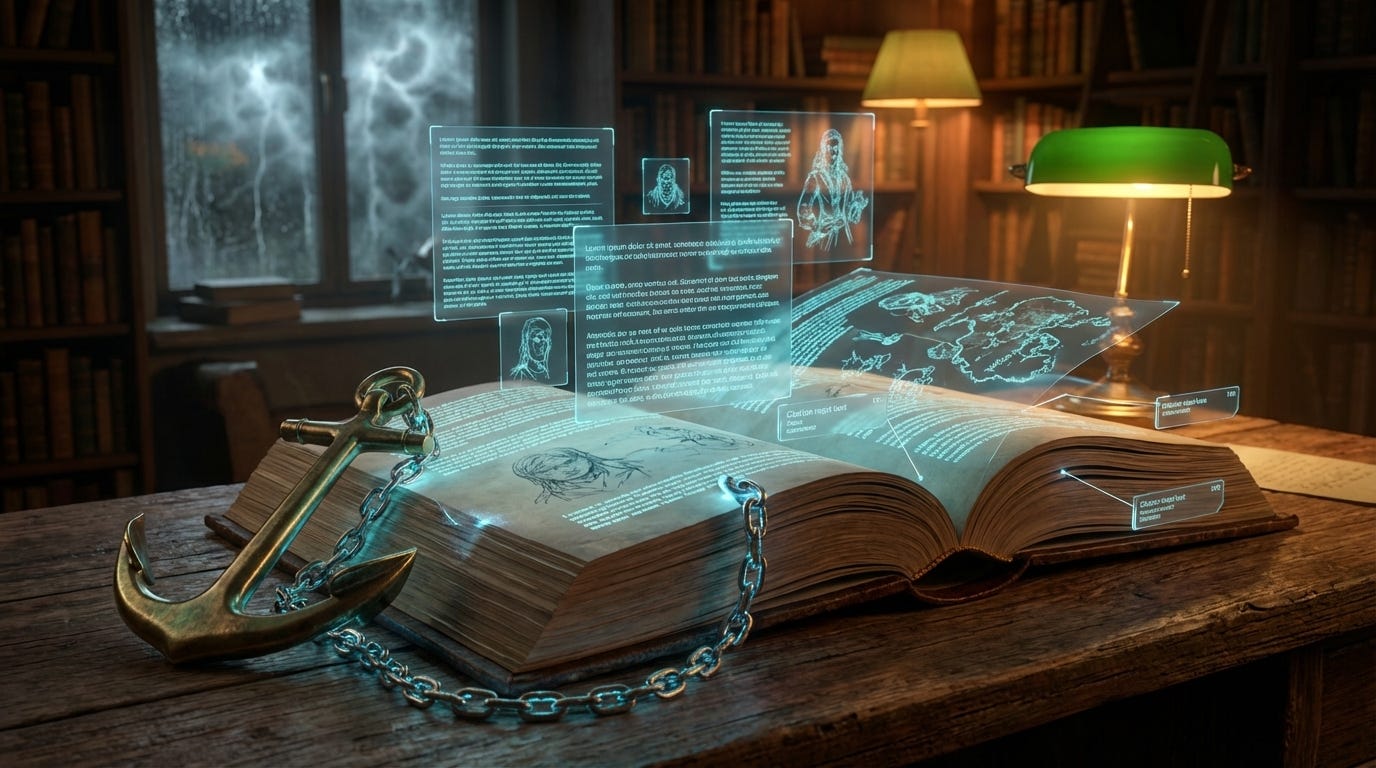
For the modern indie author, the biggest challenge isn’t just writing – it’s retention. As a series grows, keeping track of character arcs, magic systems, and timelines across multiple books becomes a massive cognitive load.
While standard chatbots (like ChatGPT) act like “improvisational jazz musicians” – prone to hallucinating facts and drifting off-script – NotebookLM acts as an “Anchor.” It is a closed-resource engine that only knows what you tell it, ensuring your “Story Bible” remains the ultimate source of truth.
1. Why NotebookLM is the “Safe” Choice for Intellectual Property
The primary barrier for authors adopting AI is the fear of “data leakage” – the risk that an unpublished manuscript will be used to train future models. NotebookLM is built with a different architecture designed for privacy and precision.
The “No-Training” Guarantee: Unlike consumer-grade chatbots that may use your conversations to improve their models, Google explicitly states that data uploaded to NotebookLM is not used to train their public LLMs. Your private manuscripts stay private.
The “Closed Garden” Protocol: NotebookLM utilizes Grounded RAG (Retrieval-Augmented Generation). In a standard chat, the AI searches its vast, “open-loop” training data for an answer. In NotebookLM, the AI is tethered to your specific documents. If the answer isn’t in your “Story Bible,” the AI is designed to say “I don’t know” rather than making it up.
Zero Human Reviewers: Standard AI feedback loops often involve human contractors reviewing snippets of data for “safety.” NotebookLM’s data pipeline is strictly automated, providing an additional layer of professional-grade confidentiality.
Source Citation Mapping: Every answer the AI gives is tied to a specific paragraph in your uploaded files. This transparency ensures you can verify that the AI isn’t “drifting” into generic tropes.
2. Setting Up Your Ultimate “Story Bible”
To get the most out of the 2-million-token context window, you shouldn’t just upload your latest draft. You need to build a comprehensive “Source Library.”
The Four Pillars of Your Notebook
The Canon (Legacy Data): Upload finished PDFs or ePubs of every previous book in the series. This ensures the AI understands your established world-state.
The Lore (Technical Data): Create a document specifically for “Rules.” This includes magic system limitations, political structures, travel times between cities, and currency values.
The Cast (Character DNA): Upload character sheets that go beyond “blue eyes.” Include “Core Wounds,” internal motivations, and – most importantly – Speech Patterns. (e.g., “Character X never uses contractions and uses naval metaphors.”)
The Style Guide (Voice Data): Upload a 5,000-word sample of your “gold standard” writing. This allows you to ask the AI to “analyze the prose style of Source 4” before asking it to help brainstorm new scenes.
Quality Control: Garbage In, Garbage Out
NotebookLM is highly literal. If your notes are contradictory, the AI will identify those contradictions (which is a feature, not a bug). Clean your notes before uploading to ensure the “Anchor” is solid.
3. Actionable Workflows: From Discovery to Final Polish
A. The “Continuity Cop” (Developmental Editing)
Stop the “Scroll of Death.” Use the AI to audit your manuscript for logic leaps.
Deep Prompt: “Using the ‘Lore’ and ‘Cast’ documents as the only sources of truth, find every instance in Chapter 12 where Character A acts out of alignment with their established ‘Core Wound’. Highlight any magic used that violates the ‘Limit’ established in the Lore document.”
The Edge: Use this to catch “teleporting characters” who move across the map faster than your established travel rules allow.
B. The “Reverse Outline” & Pacing Audit
If you’ve finished a “messy” discovery draft, NotebookLM can visualize the structure you didn’t know you had.
Deep Prompt: “Generate a table of all scenes in the uploaded draft. For each scene, list: 1. The POV character. 2. The ‘Inciting Incident’. 3. The ‘Climax’. 4. The ‘Resolution’. 5. Does the character end the scene in a better or worse position than they started? (Value Shift).”
The Edge: This identifies “flat” chapters where no emotional or plot-based progress occurs, making your revision process surgical rather than guesswork.
C. The “Vibe Check” (Diagnostic Audio Overviews)
The Deep Dive Audio Overview isn’t just for fun; it’s a powerful diagnostic tool.
The Hack: Generate the “Podcast” and listen carefully. If the AI hosts spend 5 minutes talking about a side character you intended to be a minor background prop, your manuscript is likely “over-writing” that character.
Customization: Use the Notebook Guide to give specific instructions: “Act like two cynical book reviewers who love hard magic systems but hate ‘Chosen One’ tropes. Critique the protagonist’s agency in Book 3.”
D. Grounded Brainstorming
Unlike a standard AI that gives generic suggestions, NotebookLM brainstorms within your world.
Deep Prompt: “I need a name for a new city in the Southern Province. Based on the naming conventions used in ‘Source 2: World Map’, suggest 5 names that follow the linguistic root ‘Kael-’ and explain why they fit the culture.”
4. The NotebookLM Advantage
While generic chatbots act as creative partners, NotebookLM functions as a specialized Developmental Editor. Here is why it remains the superior choice for authors:
Privacy First: Your data is siloed. It is never used to train global models or shared with human reviewers.
Zero Hallucinations: Because it is “Grounded” in your sources, it won’t invent a secret brother for your protagonist unless he’s in your notes.
Context Mastery: With a 2-million-token window, it can “remember” a 10-book series simultaneously – something no human or standard chatbot can do reliably.
Evidence-Based Answers: Every response includes direct citations to your text, allowing you to click and verify the AI’s logic instantly.
Pro Tip: Use NotebookLM to protect the integrity of your series. Let the AI handle the “remembering” so you can handle the “feeling.”
Great article, thank you. I don't write novels, but I do write. I've been using chatgpt for a while, for various uses, and recently started using gemini. As great as they are, I've repeatedly run into many of the problems you've mentioned. I think I may need to give the NotebookLM a peek. Thanks again and best wishes!