


One of my books has an audiobook narrated by Amazon’s Virtual Voice. It cost me nothing to make. The reviews it collected sit at two and three stars, and the complaints are about the narration, not the story.
Most comparisons of AI narration tools rank them by price. The cheapest options are free, so they win. But a free narration that drags your rating down on Audible is the most expensive audio you can buy, because every one-star listener is also a reader who won’t try the next book.
So I judge these tools differently now. What does a listener hear in chapter three, when two characters are arguing? And how much does it cost me to get that scene right?
By that measure my pick is Spoken (spoken.press).
The free options, and what they’re built for
Google Play Books will auto-narrate your ebook for free and pay you 52% of every audiobook sale. Google is honest about where it works: non-fiction, and titles with limited dialogue and emotional content. That rules out most genre fiction. Military sci-fi is largely people shouting orders at each other.
Spotify for Authors launched a free creation tool in September, built on ElevenLabs voices. You get five books free, with one digital voice per book. Before anything goes live on Spotify you can check pronunciations and preview chapters. The engine underneath is good. Spotify’s documentation says nothing about giving characters their own voices, though, and the tool is limited to US authors writing in English. I write in English and most of my listeners are American, but my account sits in Poland. KDP Virtual Voice is free and locked to Amazon. You already know what I think of it.
ElevenLabs: great voices, and a meter that never stops
ElevenLabs powers a lot of this market, Spotify’s tool included. Its voices are impressive. My problem is the credit system.
The Pro plan costs $99 a month for roughly 600 minutes of narration. A 90,000-word novel runs about ten hours, so one clean pass fits inside the plan. Nobody gets a clean pass. Every mispronounced name, flat line, misplaced pause or line read in the wrong character’s voice costs credits to regenerate, at about $0.17 for every minute over the allowance. In my experience the real bill lands at about double the clean-pass estimate, which puts a novel around $200.
What bothers me is what the meter does to your judgement. When every retake costs money, you start accepting close enough. Close enough is how you end up with a narrator mangling your main character’s surname for ten hours.
Free until it sounds right
Spoken flips the payment model. You build and proof the whole audiobook for free and pay only when you export or publish. I’m not a subscriber. I’m about three quarters of the way through producing Rising Storm and haven’t paid a cent yet. Redoing a line twenty times costs nothing, so I redo it twenty times.
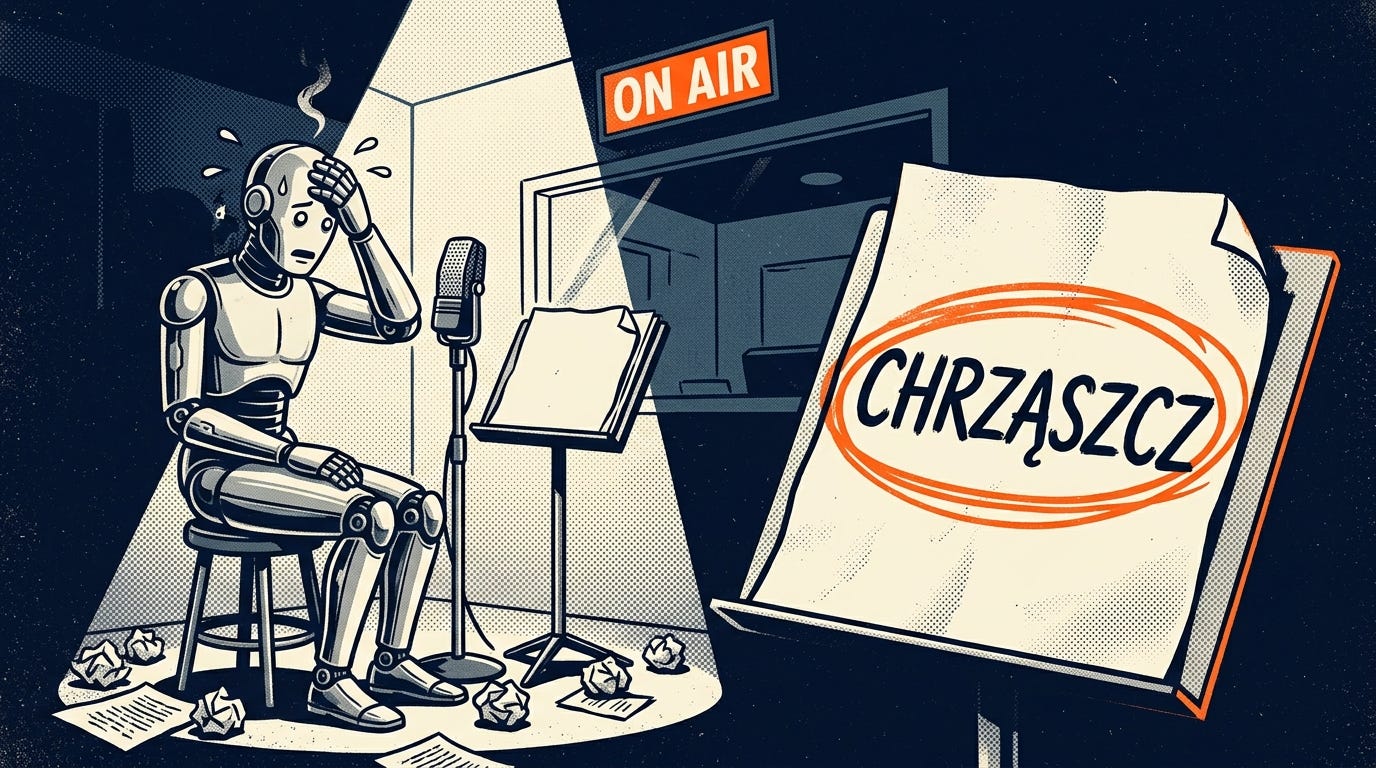
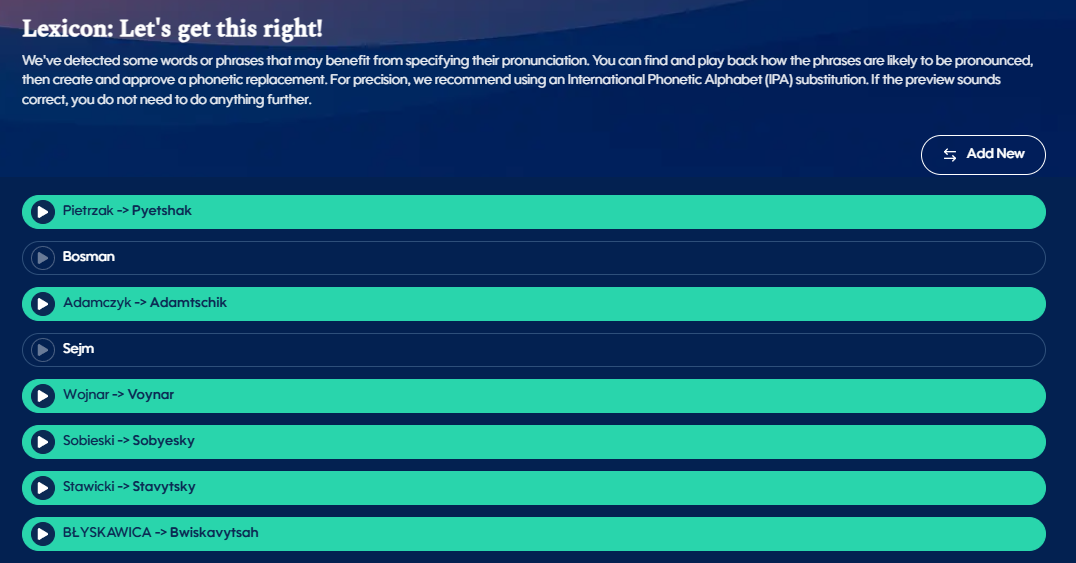
Pronunciation is where it earned my loyalty. My books are full of Polish names, and most AI voices treat them like typos. Spoken scans the manuscript, flags the words it expects to trip over and lets you play each one back. If it sounds wrong, you type a phonetic respelling (or IPA, if you know it) and the fix holds for the whole book. Pietrzak became Pyetshak. Błyskawica, the hero ship, became Bwiskavytsah. Names it already says correctly, like Bosman, need nothing. One name still defeats it: Chrząszcz, a military code name in the books. No English speaker, human or AI, can pronounce it, which is the whole point of picking it as a code name.
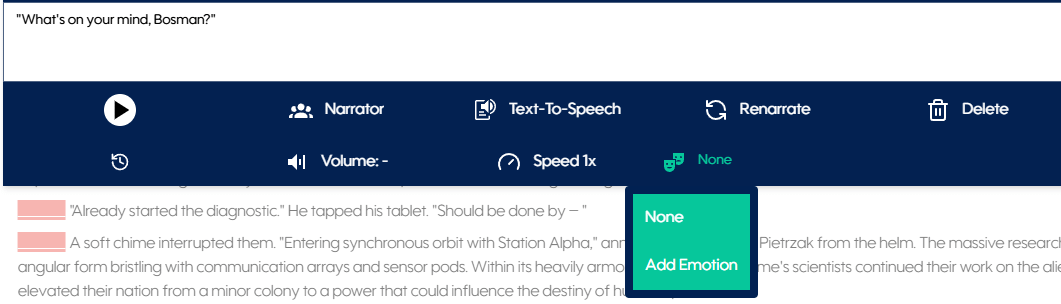
It also recently added emotion controls. Every passage now has an Add Emotion option next to the narrator and speed settings, so you can tell a line how to land, whether that’s furious or exhausted. For dialogue-heavy fiction this matters more than any voice sample on a sales page.
Spoken’s headline feature is multi-cast narration, where each character gets a separate voice. I’m using a single narrator for now, because Rising Storm has more speaking characters than I want to cast. My next book has one human and a cat, and I’m curious what a full cast makes of that. Spoken commissioned Edison Research to test multi-cast in May 2026: 1,005 US fiction listeners heard the same sci-fi excerpt either from a professional human narrator or from Spoken’s multi-cast version, and the multi-cast scored higher on favourability, 61% to 53%. Weigh that with care. Spoken paid for the study, and each listener heard only one version. On passages without dialogue, the human narrator still won. It tells you a full AI cast can hold its own in dialogue, not that AI beats people.
What it costs
Non-subscribers pay $20 per 5,000 words in Manual Mode and $30 in Magic Mode, the one-pass multi-voice option. For a 90,000-word novel that’s $360 or $540.
A $50 subscription halves those rates. The same novel then costs $180 or $270, plus $50 for the month. The subscription cancels any time, which suggests the obvious play: build and proof the book for free, subscribe for the month you export, cancel.
Even with that trick, Spoken costs more on paper than a realistic ElevenLabs bill. You’re paying for a fixed price and the freedom to be fussy. The more proofing a book needs, the better that trade gets.
What you own, and where it can go
Spoken’s terms assign the finished audio to you. There’s no royalty share and no exclusivity. Downloads go through Spoken’s own export feature, so keep local copies of every file.
Distribution is where it quietly beats most tools. Voices by INaudio, which reaches the wide retailers and libraries, accepts AI narration only as a package straight from Google Play, ElevenLabs or Spoken. Kobo accepts AI audio as long as the narrator is listed as a synthesized voice. I’m distributing Rising Storm through Author’s Republic. Whether it reaches Audible is still open: ACX, Audible’s own upload route, requires human narration unless Audible authorizes otherwise, and says it’s working on accepting third-party AI narration.
If your book is mostly one voice talking to the reader, take Google’s free narration and move on. If it’s mostly people talking to each other, the free tools will cost you in reviews, and that’s where I’d spend the money.