


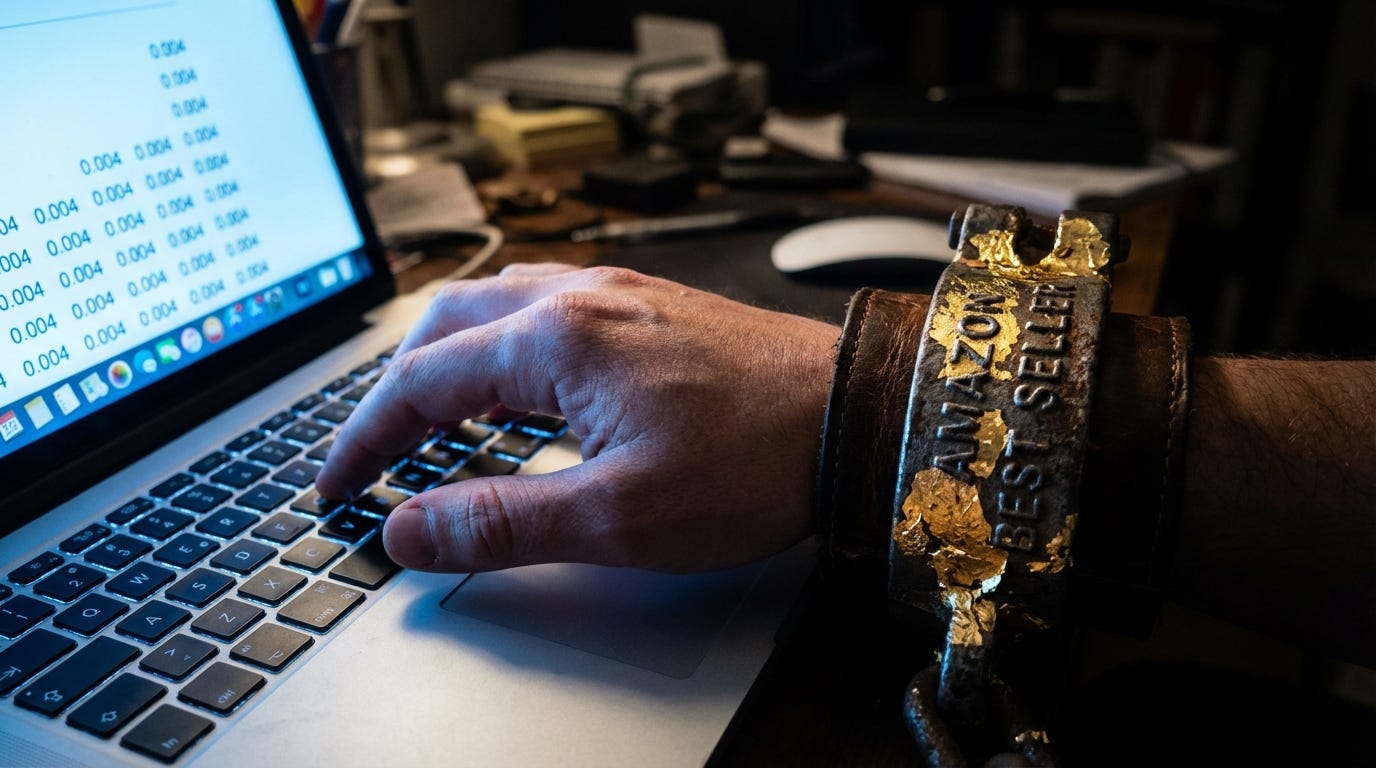
You’re staring at a Best Sellers Rank (BSR) in the triple digits. Your book is rubbing shoulders with titans. You’re “trending” in three sub-categories. On paper, you’ve made it. But when you check your KDP dashboard at 2 AM, the numbers don’t add up. You’re moving thousands of units, yet you can barely cover a week’s worth of groceries.
Welcome to the Kindle Unlimited “Visibility High.” It’s an algorithmic trick designed to keep you exclusive, underpaid, and terrified of the exit.
The Math of the “Penny Payout”
Amazon markets the Global Fund as a growing mountain of cash – $64.9 million in December 2025 alone. But that mountain is a mirage. As more authors pile into the program, the “penny payout” stays stuck between $0.004 and $0.005 per page.
Let’s look at the math that Amazon hopes you don’t do:
If you sell a book wide for $4.99, you pocket about $3.40. To get that same $3.40 in Kindle Unlimited, a reader has to finish 850 pages.
That’s three full-length novels. You are effectively giving Amazon a 65% “volume discount” on your labor just to keep your seat at the table. If you write novellas or short non-fiction, the situation is even grimmer. You’re essentially working for tips.
BSR: A Vanity Metric for Content Contractors
The Amazon algorithm treats a KU “borrow” with the same weight as a full-price purchase. This is the bait. Because there is zero friction for a subscriber to hit “Read for Free,” your BSR sky-rockets.
This creates a dangerous feedback loop. You see the high rank and assume your business is thriving. In reality, you aren’t an independent retailer – you’re a content contractor. You are “renting” your intellectual property to Amazon to help them retain their $11.99-a-month subscribers.
The moment you try to leave, the “Velocity Collapse” hits. The borrows stop, the rank craters, and Amazon’s recommendation engine – the “Also Bought” carousels that once fed you – suddenly forgets you exist. This isn’t a marketplace – it’s a walled garden with a very steep cliff at the edge.
The Algorithmic Lock-In
The real trap isn’t just the low pay – it’s the psychological leverage. Authors stay in KDP Select because of “Affinity Decay.” After months of training the algorithm to see your book as a “KU title,” your organic ties to the wider market have withered.
You fear that going “wide” to Apple or Kobo will kill the book. And in the short term, it might. But staying is a slow death by a thousand fractional pennies.
Breaking the Fever
Moving away from KU requires a shift in how you measure success. You have to stop chasing the vanity of a high BSR and start looking at Customer Lifetime Value (CLV).
Data from 2024 and 2025 shows that authors who sell direct or go wide see a CLV that is 3x to 5x higher than those trapped in the KU ecosystem. Why?
You own the data: You get the emails. Amazon doesn’t.
You capture the margin: No “850-page” break-even points.
You build resilience: If Amazon changes a “black box” rule tomorrow, your business doesn’t vanish.
Kindle Unlimited is a visibility drug. It feels great while you’re on it, but it leaves your business hollow. It’s time to trade the illusion of chart position for the reality of a profitable, independent brand.
I went wide years about 3 years ago and it's the best decision I've made. Readers there are more likely to pay full price for books. Often my wide income now beats that from Amazon.
Thanks for sharing this deep dive into KDP Select and KU, Marcin. Really helpful.