


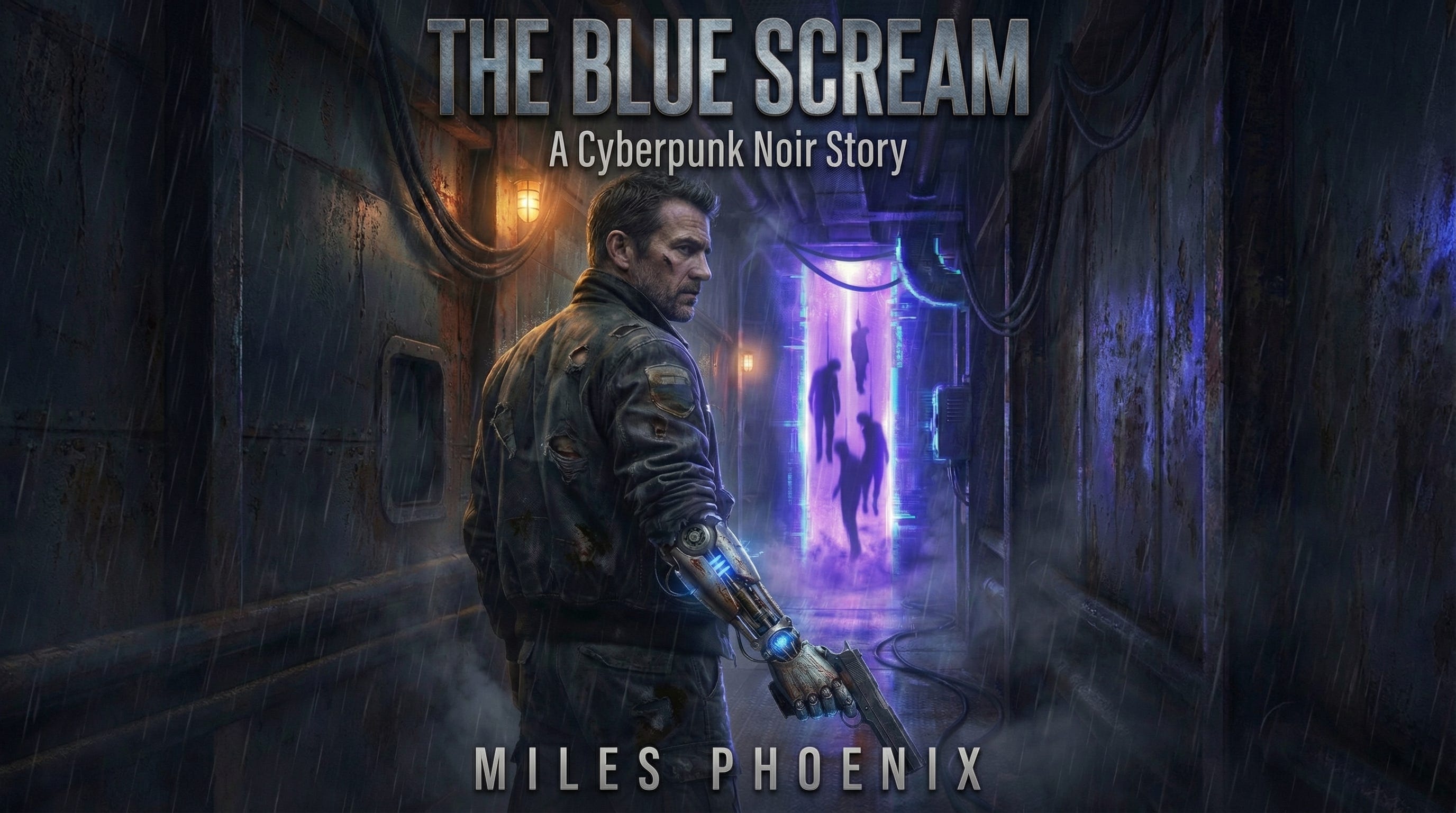
The rain wasn’t rain. Hadn’t been for years.
What fell on the Historic District was the Spire’s waste – atmospheric condensate wrung from ten million recycled breaths and pumped through scrubbers the size of tenement blocks before being spat back out over the lower city. It hit the iron grate above Vic’s shop in an oily drumbeat, each drop leaving a faint iridescent smear on the corroded iron. The Spire relieving itself on the poor. Same as always.
Vic didn’t look up.
He had the sensor array’s casing peeled back on the workbench, its guts exposed under the magnifying lens – a tangle of copper trace lines, solder joints, and logic boards packed so tight a surgeon would’ve found them claustrophobic. The lens was clamped to a bent steel arm he’d welded himself from a collapsed gear bracket, and it threw a hot white circle of light across the work. Everything outside that circle was amber shadow, the room lit by three CRT monitors stacked against the far wall, their phosphor screens painting the ceiling in sickly green pulses.
The array was Naval grade. Which meant it was illegal to own, illegal to repair, and worth exactly enough credits to keep the lights on for another two months.
He pressed the soldering iron to a fractured joint. The iron was old enough to have a brand name stamped on it, the letters long since burned to ghosts. A thin ribbon of smoke rose and bent sideways in the draft from under the grate, and the smell – flux and hot metal and the faint chemical ghost of someone else’s circuits frying – settled into the back of his throat. He’d stopped tasting it years ago the same way you stop hearing the maglev hum. It was just the flavour of the room now.
His left hand reached for the component tray.
The arm stopped.
Not gradually. Not a tremor or a slowdown. It just stopped. Locked at the elbow, fingers half-curled, the chassis shuddering with a high, thin whine that climbed toward a frequency Vic felt more in his back teeth than his ears. Like a fan belt slipping on a frozen morning. The servos cycled twice, hunting for a reset they couldn’t find, and the fingers curled a little tighter and stayed.
He exhaled through his nose.
He picked up the arm with his right hand, held it steady, and smacked the elbow joint hard against the edge of the workbench. The metal rang against metal. The whine dropped. The servos clunked through their cycle and the arm unlocked, fingers splaying open, and he put it back down on the bench without looking at it.
Same as last week. Same as the week before.
The arm was a relic from the old Błyskawica – salvage from a decommissioned service chassis that the Navy had scrapped when the war stopped and the accounting started. He’d bolted it on himself in the back of a transport with a bottle of surgical antiseptic and a calibration kit that was already three firmware revisions out of date. That was eight years ago. The thing had never been painted. The unpainted titanium alloy had gone the colour of old dishwater in the damp, and the elbow housing was cracked along the seam where he’d hit it too many times in too many cold rooms.
He could’ve had it replaced. There were clinics in the middle districts that did military prosthetic conversions for veterans at a discount, assuming you still had valid service records, which he didn’t. There were black market options in the Undercity that asked fewer questions. He hadn’t gone to any of them.
He went back to the sensor array.
The digital lock on the array’s calibration partition was a standard Naval encryption block – a rotating cipher that would’ve taken a proper cracking rig half an hour and left a forensic trail wide enough to park a cruiser in. Vic didn’t have a cracking rig. He had a manual voltage spike kit: a battered chassis of capacitors and hand-wound coils in a steel box about the size and weight of a housebrick, connected to the array’s power rail by a pair of alligator clips.
He set the spike voltage by hand. Turned the dial. Physical click for each increment.
He tripped the capacitor.
The lock partition browned out for 0.4 seconds, went dark, and came back up with its authentication cycle reset to factory state. Open. Clean. No forensic shadow because there was nothing digital to leave a shadow. Just voltage. Simple physics.
He made a small sound that wasn’t quite satisfaction. He set the voltage kit aside.
“Machines are honest,” he said to the room. His voice came out rough from disuse. There was a deactivated maintenance bot slumped against the wall behind him, its casing open, three of its four manipulator arms in a tray on the shelf above. He talked to it sometimes. It never had opinions. “People lie. Machines just break.”
He reached across the bench and lifted the bottle of śliwowica. Synthetic – the real stuff hadn’t crossed the blockade in six years and cost accordingly. The synthetic version tasted like plum mixed with industrial solvent. He’d stopped noticing which part was which.
He drank.
The alcohol hit the back of his throat in a spreading burn, and with it came the voice, unbidden and unwelcome, the way those things always are:
You can’t fix a machine if you don’t respect its ghost, Wiktor.
Król’s voice. Specific. Precise. The workshop on Błyskawica, the smell of fresh solder and cold coffee, and Król’s hands – steady, deliberate, never wasted – moving across an open chassis.
Vic set the bottle down and looked at the sensor array.
He picked up the soldering iron.
***
The door chime went off like a hornet trapped in a tin can.
Vic’s hand shot to the soldering iron before his brain caught up. He set it back in the cradle, stood, and crossed to the small CRT security monitor bolted to the wall above the coat hooks. The screen showed a fish-eye view of the street – level entrance – a gray, grainy image, the camera housing cracked and letting in moisture that fogged the bottom third of the picture.
A figure was folded against the door frame. Not standing. Folded – the way a body goes when the legs stop cooperating. One hand pressed flat against the rain-slicked glass panel, the other hanging loose, knuckles dragging the wet stone. The head lolled forward, chin to chest.
Vic watched for three seconds. Looking for a shadow, a second figure holding back in the dark of the stairwell. Nothing. Just the shape slumped against his door, and the oily rain hissing down the steps around it.
He pulled a short pry bar from the tool rack – not a weapon, just a tool he happened to keep in his hand – and hit the door release. The magnetic lock chunked open with the sound of a failing starter motor.
The figure came with the door.
The kid crashed through the gap and into the shop, his momentum carrying him sideways into the rack of cooling units along the near wall. The rack went over with a sound like a truck shedding its load, sending components skidding across the bare concrete. The kid went down with it and landed face-down on the floor in a spreading puddle of his own rainwater.
Vic stood over him, pry bar still in hand.
The kid was young – twenty, maybe less. He wore a salvage worker’s vest over a thermal layer, both soaked black with rain. His boots were mismatched, one of them a genuine Naval-issue pull-on with the rank tags ripped off. His skin was the color of old candle wax, and he was breathing in shallow, ragged pulls.
Then Vic saw the veins in his neck.
They pulsed. A cold, rhythmic blue light pushed through the skin with each heartbeat, tracing the branching architecture of the vascular system like fibre-optic cable carrying a live signal. It was faint but definite, a bioluminescent tide rising and falling beneath the flesh.
Vic crouched. The smell hit him: ozone, sweat, and something else under it, something that reminded him of hot solder and burning insulation.
He grabbed the kid’s shoulder and rolled him onto his back. The kid’s eyes were open. The irises were… wrong. They weren’t just blown wide. The geometry inside them was moving, the colour fracturing into interlocking shapes that shifted and realigned in rapid, silent cycles, like a kaleidoscope that couldn’t settle.
“What are you on?” Vic said, hard and flat. “Blue? Neon? Talk to me.”
The kid didn’t answer. His mouth was open slightly, and from somewhere in his chest came a sound that shouldn’t have been possible. A low, multi-tonal thrum, like three frequencies running through the same wire simultaneously. It resonated in Vic’s back teeth. On the workbench behind him, something rattled: a loose screw in a tray of components vibrating against its neighbours.
The sound wasn’t pain. That was the worst part. The kid’s face was slack – not agonized, not afraid. He was harmonizing with something Vic couldn’t hear.
Vic caught the kid’s jaw in his right hand, steadying the rolling head. The kid’s gaze drifted, slow and enormous, until it landed somewhere in the vicinity of Vic’s face.
Then the kid grabbed Vic’s left arm.
He grabbed the cybernetic one – the unpainted steel forearm – and his grip was wrong, far too strong for the wasted muscle visible beneath his skin. His fingers clamped around the housing like a vice.
The servos in Vic’s wrist fired without instruction. They whined up in pitch, matching the thrum coming from the kid’s chest, the two sounds finding the same frequency and locking in. The gyros in Vic’s elbow stuttered. The feedback ran up the arm into the shoulder socket, a sensation like biting tinfoil on a cracked filling.
The kid’s mouth opened wider. What came out of it was not language. It was a burst of static – hard, clipped, digital – the sound a modem made dying. Binary noise, formless and dense. Then, cutting through it, clear and human and absolutely terrified:
“Horizon.“
One word. Then the kid’s back arched off the floor.
The neural jacks at the base of his skull – cheap, street-grade sockets with visible oxidation on the contacts – lit up and threw sparks in a tight, vicious arc. The smell changed instantly: ozone, yes, but underneath it something wet and irreversible. Cooked meat and scorched copper.
The grip on Vic’s arm released.
The kid dropped back against the concrete and didn’t move again. The blue light in his veins dimmed, pulse by pulse, until it was gone. The thrumming stopped. The loose screw in the tray went silent.
Vic stayed crouched over the body for a long moment, his mechanical hand open at his side, the gyros still cycling down with a low whir.
He stood. He went to the door and threw the deadbolt – the manual one, a heavy sliding bar that no signal could retract. Then he did a methodical sweep of the kid’s pockets. No ID. No credsticks, no keys, no phone. The vest had nothing in it but a damp cloth and a bent stylus.
He found it in the boot – the Naval one. Tucked into the lining between the inner wall and the insole, wrapped in a strip of heat – shield tape that crinkled when he peeled it back. A data cylinder, short and thick, about the diameter of a man’s thumb. Military-grade casing, brushed steel with a polymer over – mould on the grip end. He turned it over. No markings on the outside, but the construction was specific – the seam tolerance, the type of locking collar at the read – head. He’d seen the same design once before, in the intelligence office aboard the Błyskawica. Black Box hardware. The kind used for recordings that were never supposed to leave the hull.
He carried it to the workbench and sat.
His proprietary reader was a cobbled mass of cannibalized hardware – a Naval deck interface married to a civilian chassis with hand-soldered connections and three different power regulators stacked in series. It looked like something that had survived a house fire. He slotted the cylinder into the collar, heard the magnetic pins engage with a heavy click, and called up the decryption prompt on the CRT monitor.
Standard Naval Intelligence encryption. Fourteen-character rotating key. Commercially, it was impassable without a specific certification token.
Vic typed in a string from memory. Not a hack. A maintenance backdoor written into the Błyskawica‘s refit documentation to allow system-level diagnostics without command authorization. He’d written part of it himself, in a cargo bay at 0300, three days before they stripped his clearance.
The lock released.
The screen filled.
Not data. Not a map or an account ledger or a set of coordinates. Code. A vertical cascade of it, dense and fast, scrolling from top to bottom in a continuous stream that made the phosphor glow in the green dark of the shop.
Vic’s right hand went flat against the edge of the workbench. He leaned in.
He recognized the syntax in the first four lines. He’d spent eight months staring at variations of it in the guts of the Błyskawica‘s core – the Origin Alpha base architecture. The raw alien framework, pre-filter, before Król’s team had dressed it in human-readable logic and damped down the recursive loops that made the standard compiler throw errors and catch fire. It was the digital equivalent of a language that thought in four dimensions expressed on a two-dimensional page: structured, but only barely, with a grammar that implied processes for which human engineering had no vocabulary.
He’d seen it. He’d filed a report about it. That report had been the beginning of the end of his career.
But this wasn’t the same.
The Alpha syntax was there, intact, running as the substrate. But threading through it – spliced at irregular intervals, erupting into the clean recursive structure like a crack in a pressure hull – was something else. Something that didn’t follow the Alpha grammar. Something that used the same base characters but assembled them into configurations that the Alpha code’s own logic should have rejected. It was jagged where the Alpha was fluid. It repeated in ways that felt less like programming and more like a stuck record. Like damage.
Like screaming, transcribed.
Vic straightened up slowly. The cigarettes were in the breast pocket of his flight jacket, hanging on the hook by the door. He retrieved the pack without taking his eyes off the screen for more than a second, shook one out, and lit it from the pilot flame of the soldering iron. The first drag burned the back of his throat and tasted like the inside of an old engine.
He stood in the amber and green dark of the shop, smoke rising in a thin column toward the damp ceiling, and looked at the dead boy on the floor. Then at the screen.
Someone had gone into the Błyskawica‘s core – not the surface systems, not the nav computers or the weapons firmware, but the deep core, the part Vic had been fired for looking at. They’d pulled the raw dreaming architecture out of the shielded lattice. And then something had happened to it. The contamination was threaded through it like rust through structural steel.
The mechanical hand trembled. Just slightly. The gyros compensating, then over-compensating, the feedback loop running a half-second behind.
Vic stared at the cascading code and said nothing for a long time. When he finally spoke, it was to the empty room, to the cooling body, to the dead green glow of the monitor.
“They cracked the core,” he said. His voice was flat, stripped of any affect. “Król’s ghost got out.”
This is just a teaser, Chapter 1 of the story I’m writing right now. I’d appreciate a feedback. And if you are curious what happens next you can join my beta-reading team.