


The literary world likes to pretend that writing a bestseller is about “discipline” or “finding your voice.” They’ll sell you $3,000 retreats in Vermont where you sit in a drafty barn and talk about your childhood.
It’s a lie.
If you look at the stats, the real secret to hitting the New York Times list isn’t a morning routine of kale juice and silence. It’s having a small, judgmental predator living in your house.
The data is in. From the gaslit studies of Victorian London to the messy desks of modern-day thriller writers, the “Cat Strategy” is the only productivity hack that actually works.
The Lap-Based Immobilization Technique
Joyce Carol Oates has written over 50 novels. Fifty. Most of us struggle to finish a grocery list.
Her secret? A cat named Cherie.
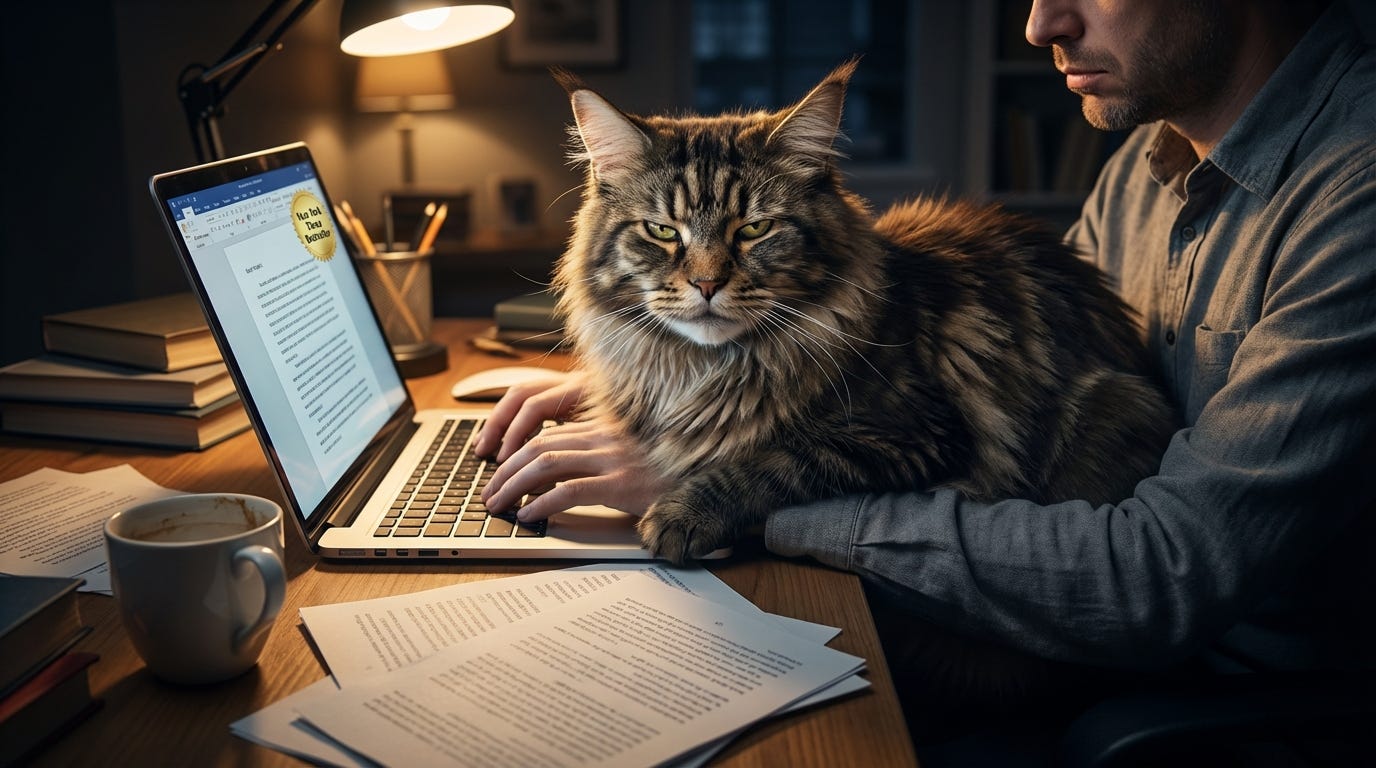
Oates once admitted that she writes so much because her cat sits on her lap. She doesn’t want to move and disturb the purr. This is the ultimate writer’s hack: physical hostage-taking. You can’t get up for a snack. You can’t pace the room. You can’t check the fridge for the fourteenth time to see if a ham sandwich has magically manifested.
You are trapped. Your only options are to stare at the wall or bash the keys. Eventually, you bash the keys.
The Keyboard Editorial Board
Gillian Flynn – the mind behind Gone Girl – had a “feline familiar” named Roy who used to sit directly on her keyboard. This resulted in manuscripts filled with things like GY*T^&$$^R^&h&&G!!!.
Most people call that a nuisance. In the industry, we call that a “structural edit.” Roy was clearly deleting unnecessary adverbs.
Then there’s Raymond Chandler. The man who defined noir had a Persian cat named Taki. He called her his secretary. He said she spent most of her time sitting on the exact piece of paper he needed to use.
The message from the cat is clear: This draft is trash, Raymond. Try again.
The Hemingway Paradox
We like to think of Ernest Hemingway as the “manly man” of letters. Bullfights, deep-sea fishing, wars, and whiskey.
But back at his house in Key West, he was a total softie for six-toed cats. He had dozens of them. He named them after Marilyn Monroe and Cary Grant.
Why? Because “a cat has absolute emotional honesty.” Humans lie. Humans hide their feelings behind “diplomatic hedging” and “synergistic frameworks.” A cat will just look at you with total indifference while you cry over a rejection letter. It’s grounding. It reminds you that no matter how many books you sell, you are still just the person who provides the wet food at 6:00 AM.
The Science of Smarter Owners
A study from Carroll University found that cat people score higher on intelligence and “non-conformity” than dog people.
Dog lovers are “rule-abiders.” They want to be told they’re a “good boy.” You can’t write a subversive, world-changing novel if you’re a good boy.
Writers are, by nature, observers. We sit in corners and watch people make mistakes. The cat does the same thing, but with better posture. Aldous Huxley used to tell aspiring novelists that if they wanted to understand human beings, they should just keep a pair of cats.
The cat refuses to serve. It refuses to come when called. It retains its wildness. If you can’t handle a creature that won’t do what it’s told, you’ll never be able to write a character that feels alive.
How to Implement the Strategy
If you’re staring at a blank screen, stop buying expensive Moleskines. Stop downloading “focus” apps that block your internet.
Go to a shelter. Find the cat that looks the most unimpressed by your presence. Bring it home.
Wait for it to sit on your lap. Open your laptop.
Congratulations. You are now legally required to sit there and write until the cat decides it’s time for dinner. That is how the classics are made. It’s not a journey. It’s not a testament to the human spirit. It’s just a hostage situation with fur.
Get to work. The cat is watching.