



My style guide for the Solar Gate series says there is no faster-than-light communication in this universe, with a single exception. In chapter 5 of Echoes of the Storm, the sixth book in the saga, a ship uses a bubble gate to hold a real-time conversation across twelve light-years. Both are mine. I never noticed.
Claude Code noticed, while checking the new book against the old ones. It’s a programming tool, and I now use it for more of my publishing work than anything built for writers.
Solar Gate is the seventh main book in the saga. The six main books and four novellas before it come to roughly 455,000 words, all of it canon now: ship names, faction politics, how many Star Cores exist and who holds them, which character calls another by his first name. Before going further with the new book, I wanted to know whether its prologue and first twelve chapters (about 31,000 words) still agreed with all of that. Nobody holds 455,000 words in their head, though series readers notice the slips anyway.
What else it found
The first continuity pass covered the prologue, the twelve chapters and my planning documents: codex, outline, concept doc, style guide. It came back with 23 issues.
The physics was wrong twice. Chapter 6 had sunlight arriving at Neptune “eight hours late,” when the real figure is about four. Chapter 7 described a signal from Earth as weeks old, though radio covers that distance in about four hours. The first error is off by a factor of two, the second by a factor of a hundred or more. Science-fiction readers write reviews about exactly this.
The dates had drifted. Solar Gate is set eight years after the previous book, when the crew has been together about ten. Chapters 1 to 11 held eighteen stale time references, most of them “five years” with a few “four years,” and the concept doc, style guide and outline said five as well. A blind search-and-replace was out of the question because “four years” was wrong in some lines and right in others. Claude listed each instance with the sentence around it, which let me check them one at a time.
The wormhole collapse needed untangling. That event, which cuts the Hyades off from Earth, is the premise of the whole book. My codex describes a scientist fleeing through the wormhole with a weapon, while chapter 4 has a prototype forced through the terminus, and chapter 1 talks about competing technologies tearing at the same patch of space-time. Side by side, they read like different events. Claude found the original scene in chapter 17 of Echoes, which let me read all of them against the source: they turned out to be one event seen from different angles. The line that was actually wrong sat in chapter 2, where “since the Hetman lost the wormhole” makes it sound as if the ship caused the collapse.
Then the small things. Chapters 9 and 10 used one set of faction names, while chapter 12 used another. One character was narrated as “Dmitri” in five chapters and as “Volkov” in the rest. This is what beta readers circle.
Why I left the writing apps
I tried the tools built for this. They were useful, but also rigid, because each one had its own idea of how an author works with AI, with fixed panels for characters and a fixed way to feed context to the model. My way of working didn’t fit. The configuration piled up faster than I could track it: I’d change a setting for one chapter, forget it, then wonder three weeks later why a session was suddenly behaving differently.
Claude Code is Anthropic’s coding agent, built to work across a large project: search it, read what’s relevant, change one file without breaking another. It runs in the Claude desktop app, pointed at a folder on your computer. Mine is a Google Drive folder that syncs to my laptop.
Why plain markdown
Markdown is plain text with a few symbols for formatting, such as a pound sign for a heading or asterisks for italics, which is about all a novel needs.
The files belong to me, in the plainest sense: they open in Notepad or any other editor on any machine, and they’ll still open in twenty years. There’s no export step, so nothing gets lost in conversion. If I want to try a different AI tool tomorrow, I point it at the same folder. Search runs across the whole saga at once, which is how a line in book eight turns up against chapter 4 of book eleven.
Drive keeps earlier versions of each file, with a catch that matters here. Google deletes old versions after 30 days, or once a file has 100 newer ones, unless you mark a version to keep forever. An agent that saves often can burn through 100 versions quickly, so mark the version you care about before a big revision. When the book is done, markdown converts to the Word file or ebook KDP expects.
The setup
Chapters/    one file per chapter
Codex/       characters, factions, ships, tech, timeline (one file each)
Notes/       running continuity state, chapter records, open contradictions
Reference/   style guide, outline, concept doc, and the ten earlier books, split one chapter per file
Editing/     the prompts for chapter-level and whole-book passes
The earlier books sit in Reference/ one chapter per file, so Claude can search them for a name or an event and read only the passage it needs. A short START-HERE.md in Notes/ tells every new session what to read and in what order. A file called canon-flags.md holds every contradiction found, each one waiting for me to rule on it.
Claude flags a problem. I decide what’s true. The ruling goes into that file, where every later session reads it before touching anything. The configuration is a text file I can open and read, so there’s no settings screen to lose track of.
Where the writing happens
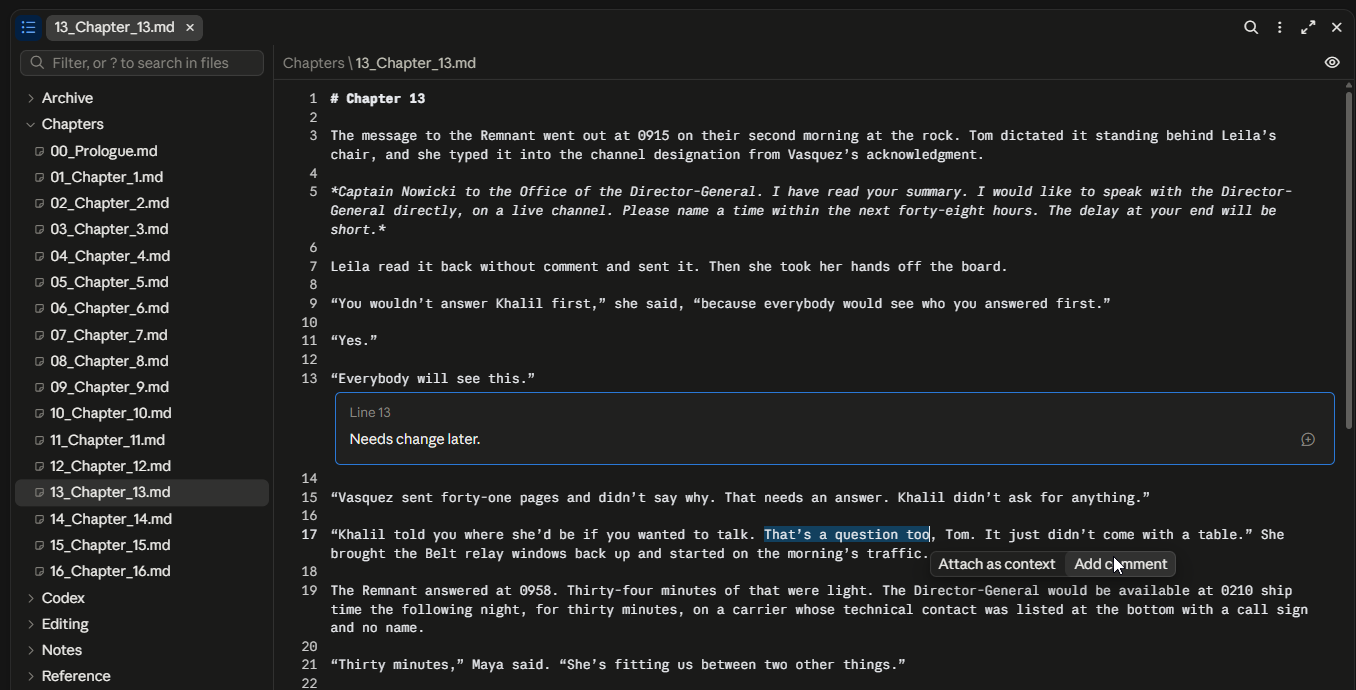
I don’t use a separate editor, because the Claude desktop app shows the whole project in a file pane on the left, with the chapters, codex, notes and ten earlier books in one tree. Clicking a chapter opens it beside the conversation, where a switch to the source view lets me edit it in the same window Claude is working in.
Starting a chapter takes one sentence: I ask Claude to create 17_Chapter_17.md in Chapters/, then open the empty file and write. When a passage needs a second look, I select it and either attach it to the conversation or leave a comment on it, so the question stays tied to the exact lines. My old tools spread this over several panels; here it’s a file tree next to a chat.
Logging now, fixing later
When a book is moving forward, I don’t want to stop and repair chapter 6. The rule written into the notes is that contradictions get logged and ruled on, while the cleanup waits for a dedicated editing pass. Nothing forces a fix in the moment.
Anyone who has run a software project knows the pattern. Specs drift from code. Docs drift from both. By release, nobody’s sure which one is true. You don’t fix it by rereading everything; you keep one file that says what’s true and check the rest against it.
Where it’s worse
It costs money: Claude Code needs a paid plan. I pay $20 a month, on top of whatever else is in my publishing stack.
It’s a technical tool, since you work in a desktop app pointed at a folder on your own machine, not a website where you log in and start typing. It has no character cards or timeline to drag around, only folders and text files, which for some authors ends the conversation.
It’s also a general tool. It doesn’t know what a novel is until your style guide and notes tell it, so an author who skips that step gets generic results. My first session went on working out the file layout, which Claude helped with, though it won’t hand you a finished template.
And I have no sales numbers for any of this. Solar Gate isn’t out yet.
Who should try this
If you write standalones and your current tool doesn’t get in your way, I wouldn’t bother, because the payoff grows with the amount of canon you have to protect. In a long series, or a backlist readers binge in order, one contradiction in book eleven earns a one-star review from someone who read books one to ten last month.