


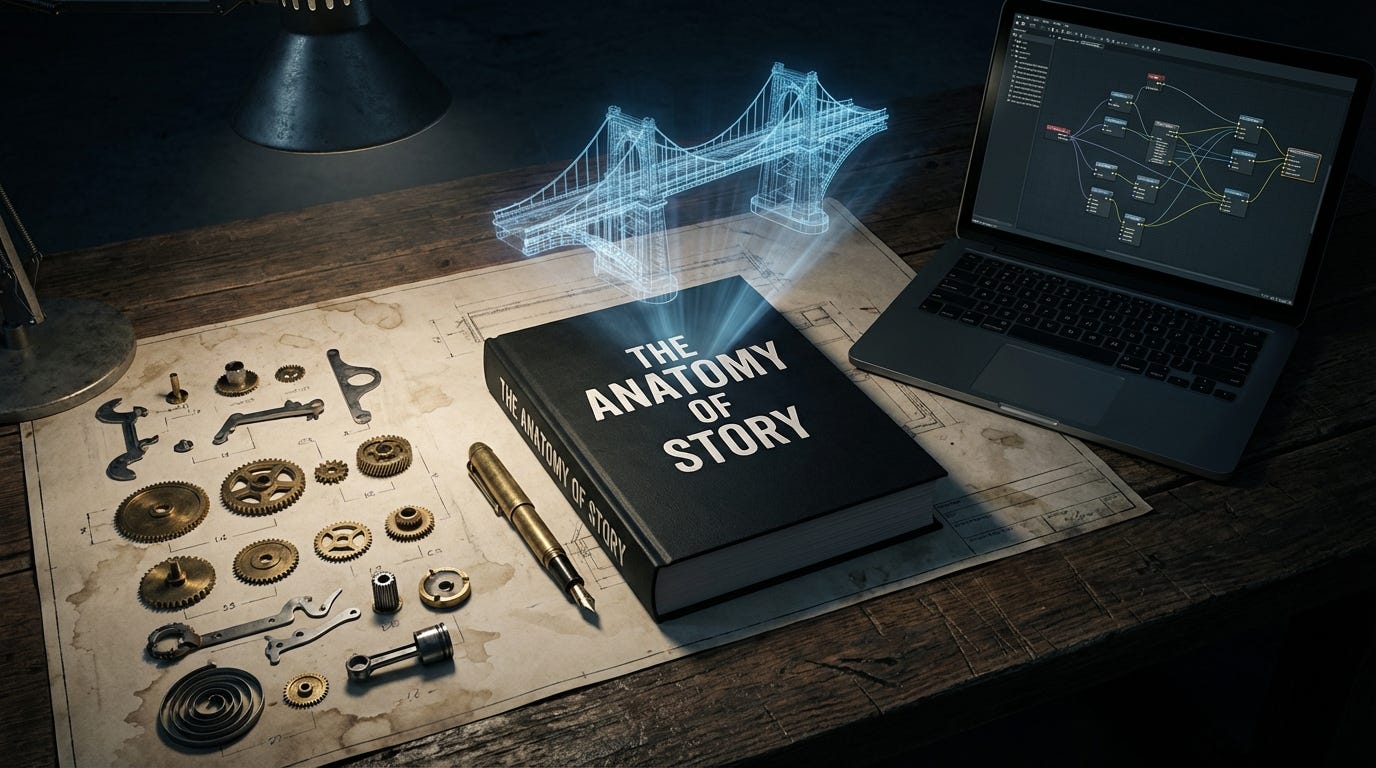
The “Rapid Release” era of indie publishing has a dirty little secret: we’ve traded depth for velocity.
We’re told to “churn and burn.” We’re told that the algorithm rewards quantity over quality. But if you look at the indies who actually build ten-year careers – the ones whose readers buy every single backlist title – they aren’t just fast. They’re architects.
If you’re tired of hitting the 30k-word mark and realizing your plot has collapsed into a heap of “and then this happened” nonsense, you need to read John Truby’s The Anatomy of Story.
Tools are Irrelevant; Structure is God
It doesn’t matter if you write with a Montblanc fountain pen on vellum or use an LLM to “collaborate” on your first draft. A tool is just a faster (or slower) way to express an idea.
If you use AI to write, you aren’t a writer anymore; you’re a director. But a director who doesn’t understand story structure is just a loud guy with no vision. Without a blueprint, AI will give you “the average.” It will give you the most predictable, statistically likely version of a story – which is to say, it will give you boredom.
If you write by hand, you run a different risk: the “Discovery Writing” trap. You wander into the woods of your own imagination and forget to pack a compass.
Truby is the compass.
Forget the Three-Act Box
Most writing advice feels like a coloring book. Save the Cat tells you to put a “B-Story” on page 25. It’s a recipe. It works, but it tastes like a McDonald’s cheeseburger – predictable, salty, and ultimately forgettable.
Truby is different. He doesn’t look at story as a set of timestamps. He looks at it as a body. He argues that a story is an organic thing that grows from a “designing principle.” It’s not about hitting a beat because a chart told you to; it’s about the internal moral rot of your protagonist forcing the plot to move.
The “Seven Key Steps” are the Secret Sauce
Indie fiction often suffers from “Goal-Sickness.” We give our hero a goal (Find the hidden map! Win the space race!) but we forget to give them a need.
Truby’s core framework revolves around the Weakness and Need.
The Weakness: What is the hero doing that is hurting others?
The Need: What do they have to learn to live a better life?
If you don’t have this, your story is just a series of explosions or conversations. It’s hollow. Truby forces you to connect the hero’s internal psychological failure to the external plot. When those two things sync up, the story feels “right” to a reader’s brain. They can’t explain why they’re crying at the end of your dragon-romance or techno-thriller, but Truby can.
Why Indies, Specifically?
As indies, we are the CEO, the Editor, and the Marketing team. We don’t have a developmental editor at a Big Five house to tell us our “Moral Argument” is weak.
Truby is that editor.
The Anatomy of Story is a thick, dense, sometimes annoying book. He’s arrogant. He thinks his way is the only way. But his chapter on “Character Webs” alone is worth the price of admission. Instead of thinking of characters as individuals, he teaches you to see them as a web where every character serves to highlight a different side of the hero’s central problem.
The Verdict: Build a Better Engine
You can keep “pantsing” your way into dead ends if you want. Or you can spend a week studying the anatomy of what actually makes a reader turn the page.
Don’t use Truby to make your story “literary.” Use him to make it unbreakable. Use the 22-step structure to ensure your middle doesn’t sag like an old mattress. Use the “Moral Argument” to make sure your ending leaves the reader staring at a wall for ten minutes after they finish.
Stop just writing. Start engineering.
Indie Challenge: Take your current Work-In-Progress. Can you define your hero’s Moral Weakness in one sentence? If not, you’ve got work to do.
Completely agree with you. The Anatomy of Story is an essential guide to fiction storytelling. I often revisit it whenever I’m shaping an initial idea into a fully working story.