


You just finished your manuscript. You’re staring at the “Publish” button on Amazon KDP, but a voice in the back of your head is whispering about pirates, plagiarism, and AI scrapers.
Do you need a $500 lawyer? No. Do you need to register every draft with the government? Probably not.
But you do need a shield. If you want to be a professional “authorpreneur,” you have to treat your book like a business asset. Here is the lean, no-nonsense protocol for securing your work in 2026 without breaking the bank.
1. The Good News: You’re Already Protected
Under the Berne Convention – which covers 181 countries – copyright is automatic. The second you “fix” your story in a digital file or on paper, you own it. You don’t need a symbol (©), and you don’t need a certificate to exist as the owner.
The catch? Existence isn’t enforcement. If Amazon flags your book for a content dispute or a pirate site mirrors your work, “I wrote it first” is a weak argument without a timestamped paper trail.
2. Private Registration: The “Amazon Shield”
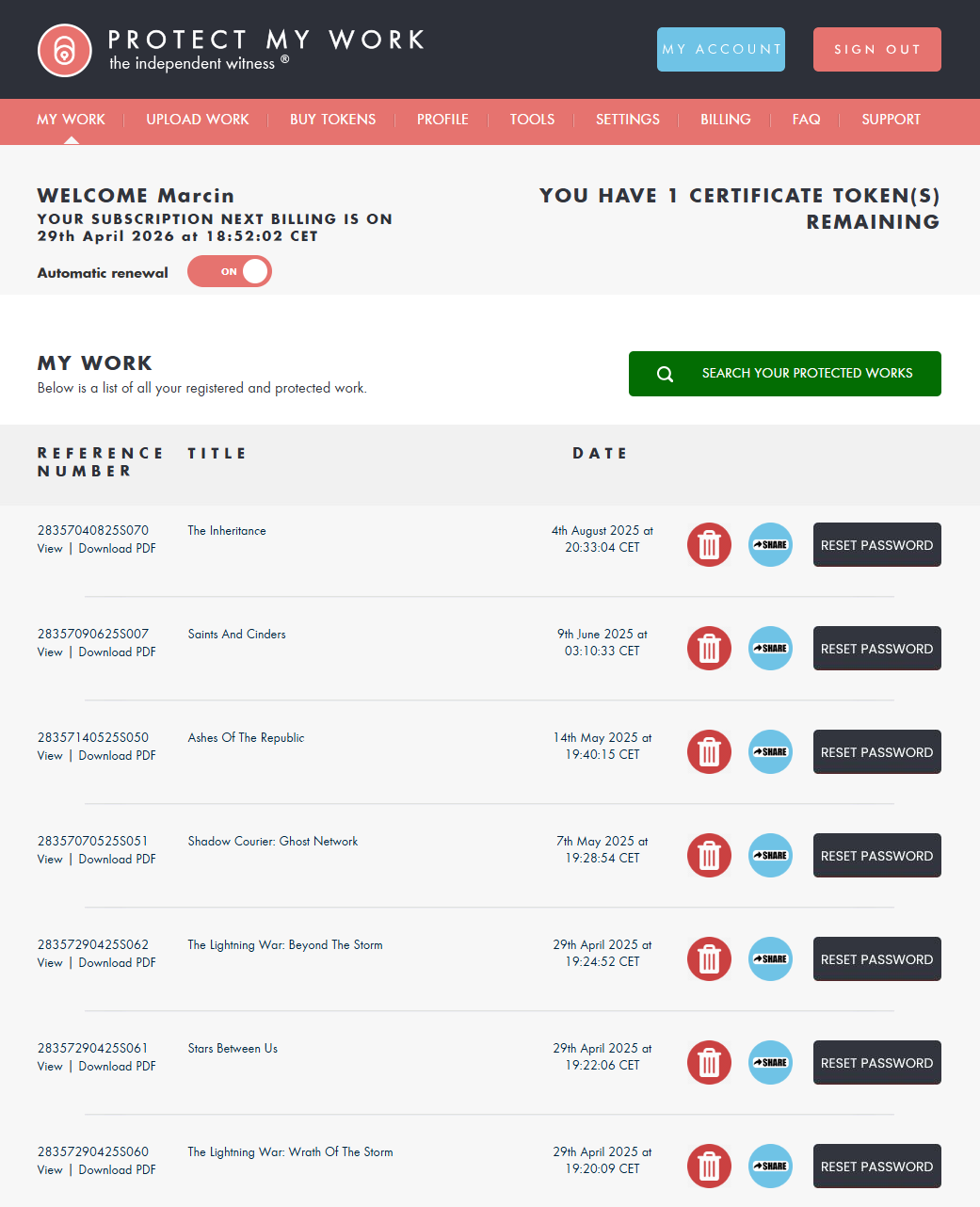
Government registration is slow (think 3-9 months). For day-to-day protection, many indies use services like ProtectMyWork.com or Copyright House.
Let’s be clear: these sites don’t “give” you copyright. They provide a third-party, tamper-proof digital timestamp.
The “Proof of Life” Factor: If Amazon KDP suspends your account because a pirate uploaded your book first, an official-looking certificate from a third party is often the only thing their support team will accept to reinstate you.
Cost: ProtectMyWork is roughly £44/year for unlimited registrations.
Is it a scam? No, but it’s limited. It won’t help you in a US federal court, but it works wonders for “DMCA” takedown notices and platform disputes. It’s a low-cost “digital notary.”
3. The US Market: The One Rule You Can’t Ignore
If you sell books in the US (and let’s be real, that’s where the money is), the US Copyright Office (USCO) is your gatekeeper. Even if you live in London, Sydney, or Warsaw, this matters to you.
While protection is automatic, legal action in the US is not. You cannot sue for infringement in a US federal court unless you have registered your work with the USCO.
For Non-US Authors: You can technically bring a suit under the Berne Convention without registration, but you lose the “Big Hammer.”
The “Big Hammer”: If you register within three months of publication, you become eligible for “statutory damages” (up to $150,000) and legal fees. Without this, you only get “actual damages” – which are usually pennies compared to the cost of a lawyer.
4. Global Strategy: Regional Nuances
UK / Australia / Canada: There is no official government registry. You rely entirely on the Berne Convention. For you, private registration services (like ProtectMyWork) or “Poor Man’s Copyright” (emailing the manuscript to yourself) are the primary ways to prove a timeline.
European Union: The EU is getting aggressive about AI. If you’re in the EU, look into EUIPO’s resources. They are increasingly focused on “Human Authorship” stickers and blockchain-based evidence systems to distinguish human work from AI-generated content.
5. The AI Minefield: Protect What’s Yours
In 2026, the law is clear: AI cannot be an author. If you used ChatGPT or Claude to write 100% of your book, it belongs to the public domain. Period.
To keep your copyright while using AI as a tool, follow the Human-Centric Protocol:
Keep the “Paper Trail”: Save your original outlines and early, human-only drafts.
Document the “Mental Conception”: Keep logs of your prompts. They prove you were the creative director.
Substantial Rewriting: The USCO and EU regulators look for “perceptible human expression.” If you rewrite 60% of an AI draft to add your voice, that new version is yours.
6. Join an Alliance
Don’t be a lone wolf. The Alliance of Independent Authors (ALLi) is the best investment you can make.
They maintain a “Watchdog” database to keep you from getting scammed by fake “copyright agents.”
Membership usually includes discounts on registration and free upload codes for distributors.
The Bottom Line
Automatic: You own it now.
Private Services: Use them for quick “proof of life” to deal with Amazon bots.
USCO: Register the final version of your “lead” books if you want the power to sue in the US.
AI: If you can’t prove a human was in the driver’s seat, you might not own the destination.
Stop overthinking the law and get back to writing. Just make sure you’ve got your shield up before you hit publish.