


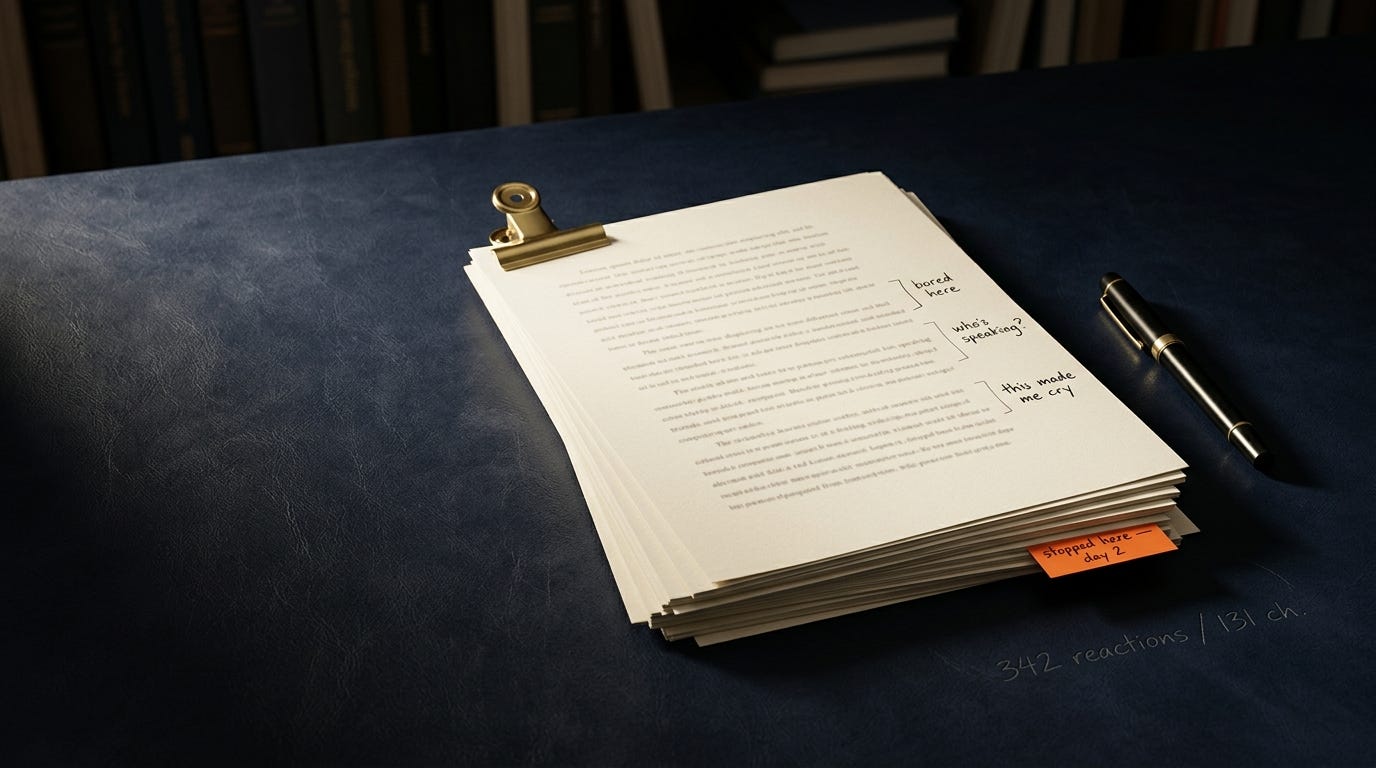
One of my beta readers gives me editorial notes, and they’ve been some of the most useful feedback I’ve had on a book. But the notes I get from every good beta reader, editor or not, are shorter. “I didn’t like this section.” “I didn’t understand this paragraph.”
Then there’s the note that tells me a scene is safe to leave alone: “This made me cry.”
None of those notes require editing skill. They need a reader who pays attention to their own reactions and writes them down with a page number. Every beta reader can do that part. Editorial notes come on top, when the author wants them and the reader has the skill. Readers skip the reactions because they feel too simple to count as help.
K.M. Weiland’s 13 Rules to Be a Better Beta Reader is the best checklist I’ve found on the subject, and I’ll borrow from it below. It’s written from an editor’s chair, though, so several of her rules assume you’re editing as well as reading.
Before you open the file
Ask what kind of read the author wants. Weiland puts this first, and she’s right. Someone who wants a gut reaction doesn’t want 400 comments on comma placement. Someone who asked for a structural read doesn’t care whether you caught the typo on page 12.
Agree on the file format and a deadline. Then keep the deadline, or tell the author early that you can’t. A beta reader who goes silent does more damage than one who says no, because the author can’t tell silence apart from “I hated it and didn’t know how to say so.” One of the commenters under Weiland’s post describes exactly that spiral.
Two more rules from her comment section belong in the main list. Only beta-read genres you read for pleasure, since you’ll know the conventions and you’ll notice when the book breaks them. If the book isn’t for you, say so early and step out. For swaps, one commenter starts with a 5,000-word trial so both sides can check the fit before committing to a full manuscript.
While you read
Keep a running log with locations: chapter and page, or a comment pinned to the paragraph. Every time you feel something, write it down at the moment you feel it. “Bored here.” “Lost track of who’s speaking.” “Wait, wasn’t she in hospital two chapters ago?” “Laughed out loud.”
Do it in real time. By the last page you’ll have forgotten where your attention slipped, and the author needs the exact spot. Kindlepreneur calls the place where a reader got pulled out of the story the most helpful feedback a beta can give. I’d add one more marker: where you put the manuscript down each day. Indie Author Magazine suggests authors ask their betas for exactly that. One reader stopping on a page could mean a busy evening. Three readers stopping on the same page is a problem in the book.
Write confusion as questions. “Why does he trust her here?” tells the author what the page failed to deliver without prescribing the fix.
Label taste as taste. “I don’t like present tense” is useful, but it’s information about you. Weiland makes the same point: your preferences count, as long as you present them as preferences and not as rules.
I built Author’s Haven, a beta-reading platform, around this idea, so take the next bit as a disclosure as much as an example. Readers highlight a passage and tag it with one of six reactions: love, confused, funny, sad, exciting or slow. They can add a written comment if they want. There’s no button for “rewrite this sentence.” As of October 2026, readers there have left 342 reactions across 131 chapters.
Where editing fits
Two of her rules are editor work. Do them when the author asks for that kind of read and you have the skill to back it up.
The first is mapping structure by page count. She splits the page count into eighths to find where each turning point should land, then checks whether the plot hits those marks. For a developmental edit that’s a good technique. If the author only asked for reactions, it pulls your attention away from the experience of reading and onto a grid. A late midpoint will show up as a sag anyway. Report the sag with its page number and let the author diagnose it.
The second is offering solutions. Her example: instead of only saying a character’s emotional reaction doesn’t ring true, suggest she show some confusion and vulnerability. From the right reader that helps a lot. A good editorial beta reader suggests a fix the author can make in their own voice. A less experienced one hands back a rewrite in theirs, which the author then has to strip out. One commenter under her post describes treating himself as a “reactive target” whose job is to show the author whether the shot landed. Weiland agreed with him in her reply.
That’s the floor for every beta read: report the hit or the miss. Readers with editorial skill can also suggest a fix. The author decides whether to take it.
Her last rule I’d keep, with one change. She tells beta readers to mark every strong emotional reaction and then to wrap the critique in a compliment sandwich. The first half matters more than she makes it sound. “This made me cry” isn’t a courtesy. It tells the author which scene to protect during revision, when every page starts to look cuttable. The sandwich I’d drop. Authors can spot the bread.
Don’t paste the book into a chatbot
This rule didn’t exist when Weiland published her list in August 2022.
Dropping a chapter into ChatGPT and asking what’s wrong with it takes ten seconds. Don’t do it unless the author agreed in writing. On April 16, 2026 the Authors Guild warned that uploading a copyrighted work into an AI system without permission may violate the author’s copyright or right of privacy, and told editors and agents not to do it without written consent. That statement targets publishing professionals. A volunteer beta reader has no contract to lean on and usually no NDA either, which makes the case against it stronger.
It also defeats the point. The author asked for your reactions, and a model’s summary of the chapter isn’t one.
The report
When you finish, send a short letter on top of the inline comments. Weiland calls it an edit letter. I’d order it like this:
Where you nearly stopped reading, and why, if you know.
Where you got confused or stopped believing the story.
What hit hardest, with page numbers.
Your preferences, labelled as preferences.
Editing suggestions, if the author asked for them.
Keep it to a page. The inline log carries the detail. The letter is where the author starts.
If you can edit, send the notes. Put the reactions first: where the book lost you, and where it got you.
So helpful, thank you!