


Every few months an author YouTuber makes the same video, and every few months I watch it, because the question underneath it is a good one even when the answer is bad. The latest comes from Kelsey Humphreys, a romcom author with thirteen novels across three pen names, and she is asking why badly written books outsell well written ones. She is honest in a way most of the genre isn’t, since her last release flopped and she says so on camera, and she spends a minute explaining that the revenue numbers other authors post online are not profit numbers. That minute is worth the twenty-five.
The rest is a list I could have written from memory: publish more, publish faster, run ads, build a brand, get rabid fans, build an email list. Most of it survives contact with the data. But the premise is wrong, and the premise is doing all the emotional work, which is the reason the video exists at all.
Nobody buys a bad book, because buying happens before reading. What a reader buys is a cover, a title, a category placement, a blurb, a price, and some social proof, and none of those six things contains a sentence of your prose. The purchase closes before your writing gets a vote. So the comparison that makes authors miserable at two in the morning, my good book against her bad one, sets two objects side by side that were never judged on the axis the question assumes.
The research is unkind about this. A study of 98 UK bestsellers from 1998 to 2012 checked Goodreads data against copies actually sold, and found that the number of ratings predicted sales far better than the level of those ratings did. Rating count measures how many people read the thing, while rating level measures whether they liked it, and only the first one moves money. A 2021 paper in the American Economic Review goes further, estimating that crowd star ratings shift consumer welfare in book publishing by more than ten times what professional critics manage. Ratings and reviews are visible before purchase, while quality is not, and that asymmetry is the entire mechanism. It isn’t a conspiracy against literary merit, whatever your writing group tells you at eleven on a Thursday.
If prose doesn’t sell the first book, what does the successful indie own that you don’t?
One number under six pieces of advice
Take Humphreys’ list seriously for a moment, because each item on it is correct and each item is a proxy for something she never names.
Quantity holds up. Written Word Media’s 2025 survey, with 1,346 respondents, shows the income curve stepping up around ten published titles and stepping again past twenty-five, while roughly 44% of the sample earns under $100 a month and about 13% clears $5,000. Ten books is not a hobby, it’s a decade of weekends, or three years of doing very little else.
Cadence half holds. The 30-day cliff is real, and publishing every ninety days does keep you inside the new-release visibility window. But the A10 rollout in the summer of 2025 changed what the machine rewards, and ALLi’s Orna Ross, writing in The Bookseller, put it plainly: the weight of evidence suggests the store now prioritises sustained reader engagement over short-term launch spikes. Rachel McLean, who won the Kindle Storyteller Award in 2021, reported no drop in sales from the change, only more rank volatility than usual. A launch spike used to be a strategy by itself, and now it’s an input.
Ads hold up as a mechanism and collapse as a number. Funnelling every advertising dollar at book one and letting the series recoup it is correct, and it is what serious operators do. Humphreys says the big names spend hundreds of thousands, and a handful of them do, but the documented indie reality sits closer to $1,300 a month at roughly 50% ACOS, with a $45,000 month quoted in the trade press as an industry high. That gap matters, since “spend hundreds of thousands” is a reason to give up, while “spend $1,300 badly for four months while you learn” is a decision you can take on a Tuesday.
Brand consistency holds up, and here there is a real paper behind it. Management Science ran Goodreads data from 2007 to 2017 and named the effect categorical stickiness: readers keep filing you under the category your earlier books established, and your most experienced readers are the ones least likely to notice you’ve moved. Humphreys lived this, since she launched a romantasy trilogy under a second pen name while marketing it to her romcom audience from the same Instagram account, and it died. She is now repositioning it as romcom fantasy. The pen name was never the problem, the audience she pointed at it was.
The email list holds up, and it holds up hardest of all. In the same survey, authors with a working list earned around $300 a month against roughly $15 for authors without one. That is not a marginal effect, it’s a twentyfold spread, and it is the starkest correlation in the dataset. Lulu’s 2025 report on 2,065 creators lands in the same place, with every author making $40,000 a year or more sitting on at least a thousand subscribers.
Six pieces of advice, and every one of them is a different way of paying for the same thing. More books means more chances that a reader who liked one will find another, faster cadence means less time for that reader to forget you, and ads at book one only make sense if books two through six earn the spend back. Brand consistency means the next book satisfies the appetite the last one created, and the list means you can tell those readers the next one exists.
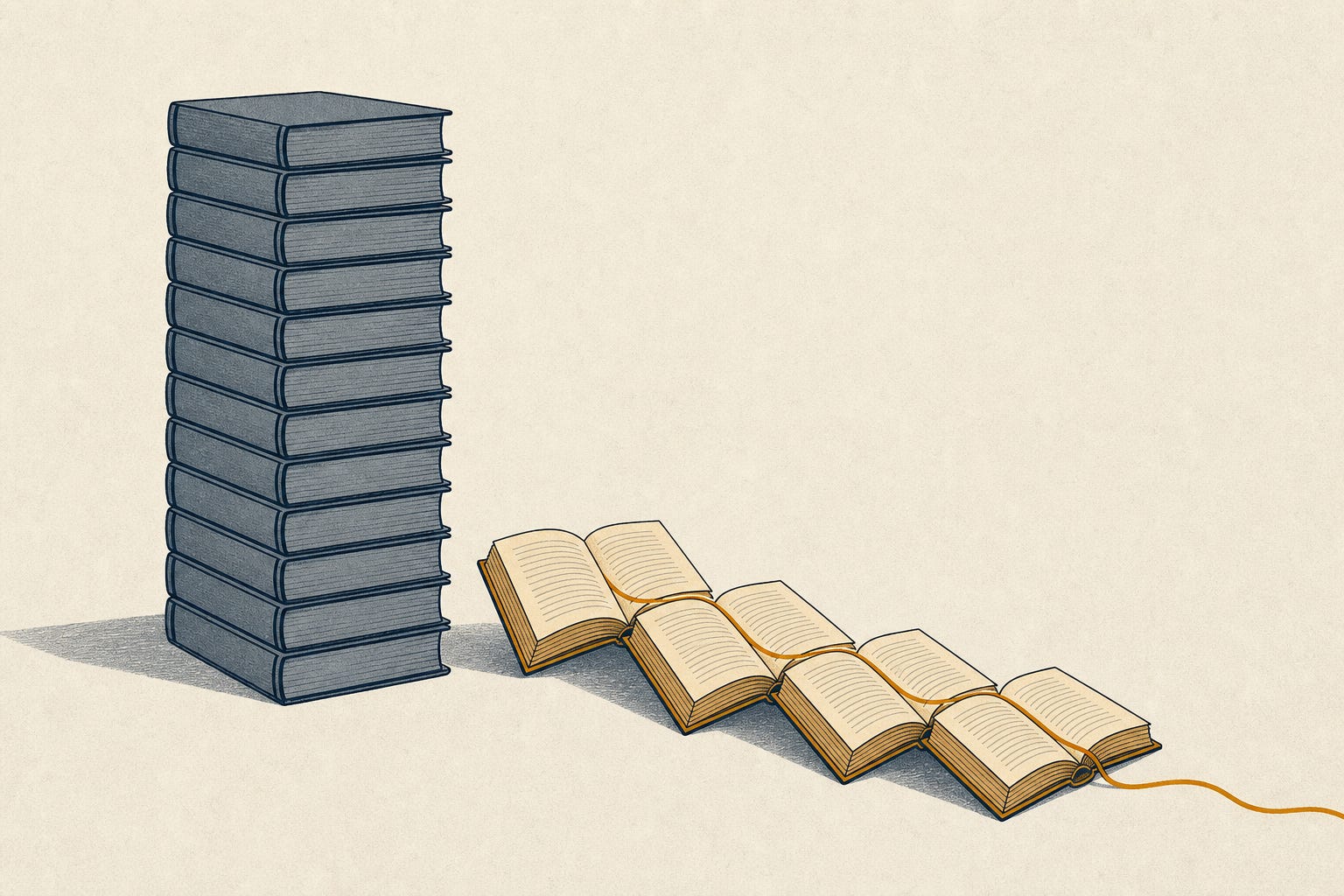
The thing being bought, in every case, is read-through.
What I can measure on my own shelf
I can’t run a controlled experiment on the publishing market, but I can read my own dashboard, and book one to book two on my main series converts at 42%. Just under six readers in ten finish the first book and don’t continue, or don’t finish it at all, and KDP won’t let me separate those two failures cleanly, which is a small scandal in its own right.
That single number is the ceiling on everything else. At 42%, a reader acquired for $3 has to earn back that $3 from a book-one royalty plus a 0.42 chance of a book two, then a 0.42 × whatever chance of a book three, and so on down a decaying chain. Push the rate to 60% and the chain roughly doubles in value without a single additional word written or ad dollar spent. Nothing else on Humphreys’ list has that much return per hour of work.
She stumbles into this herself and doesn’t notice. The best story in her video concerns a drop-off after book two in her series, and how she rewrote the ending and the back matter of that book to point harder at book three, and how she later saw a reader post about starting the third one. That is the whole argument, and she tells it as a warm anecdote with a sample size of one, sandwiched between two plugs for her paid blueprint.
Kindle Unlimited makes the stakes plainer, since there the metric is priced in public. December’s global fund was $64.9 million including the All Stars bonus, and the 2025 rate averaged $0.00445 per page, with October hitting a five-year high of $0.005. On a 300-page book that’s about $1.34 for a complete read, so a borrower who stops at 40% pays you 54 cents. The subscription economy meters your read-through every month in full view, and the number authors still argue about online is rank.
The part I’m less sure about
The market data cuts against the simple version of my story. Print was flat in the first half of 2026, down 0.3%, but adult fiction rose 5.7% while YA fiction, the BookTok category that supposedly built all of this, fell 25.6%. Manga was up 45% in the first quarter. Attention didn’t disappear, it relocated, into categories that are almost entirely series-shaped and binge-shaped, which either confirms everything above or means I am reading a manga boom as a read-through story because that is the story I brought with me.
Humphreys tells her viewers to stay a little delusional, and she is right, since it’s the only defensible reason to do this work at all. Be delusional about your prospects, though, and not about your numbers. Prose is the part you control completely, and the part the market checks last.
Informative. Thanks for sharing. 👌