


If you plan your books with an AI model, this is the part of the process most likely to hurt you, and the part nobody checks.
Most of the conversation about AI and fiction is about sentences: banned words, em dashes, detector scores. A 2026 study looked somewhere else. It compared stories by people and by five AI models and found that the AI stories share a recognisable plot shape, however the sentences read. That shape is set at the outline stage. If a model helps you plan, it can end up in your book even if you write every sentence yourself.
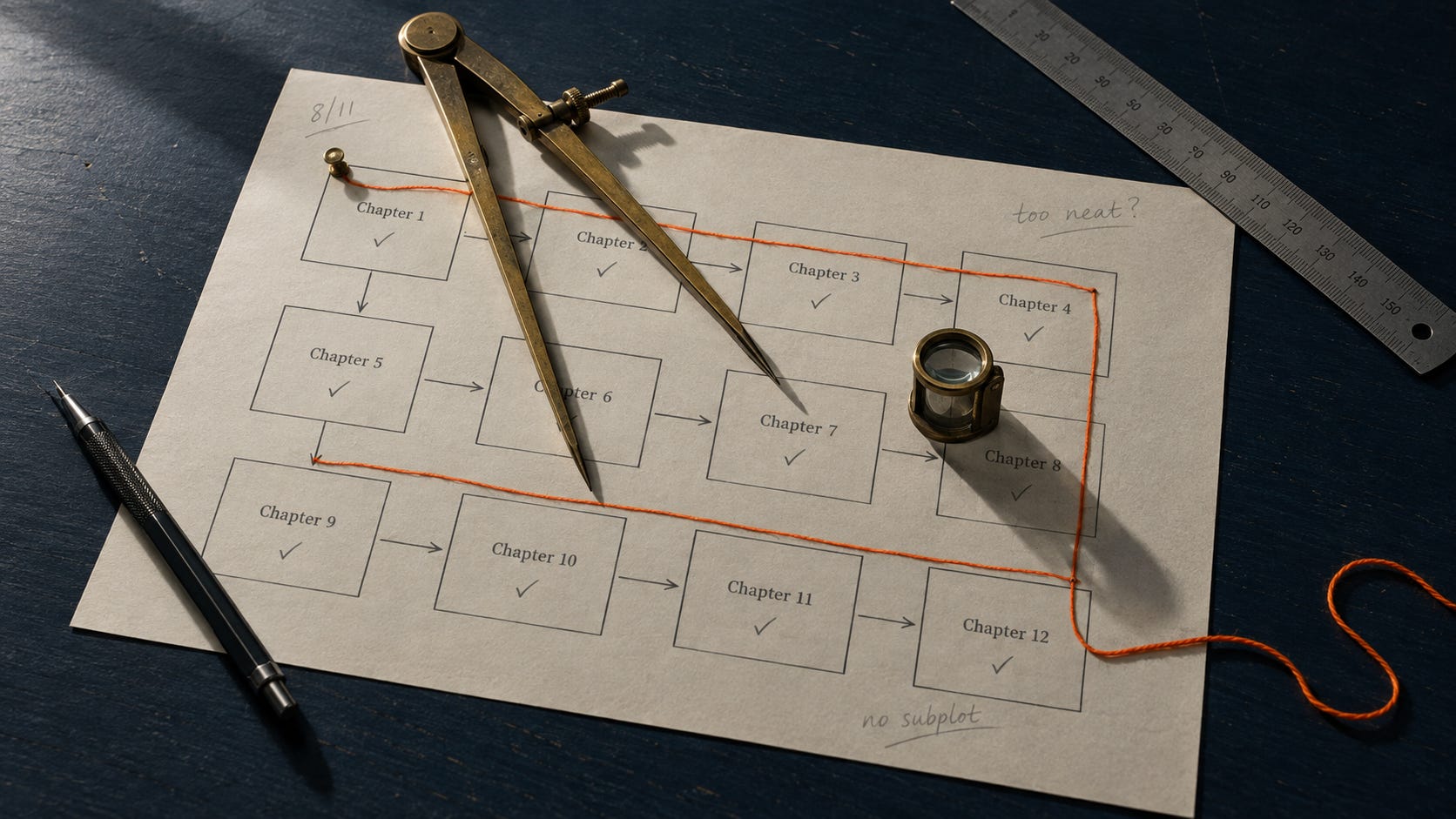
I found this out on my own book. Bastion Chronicles is a zombie-apocalypse series narrated by a vain housecat; in Book 3 his human, Sarah, drives to flooded Houston to find her sister. I brainstormed the outline for it with Claude, from my idea, with my inputs and corrections at every step. The result was a plan for a 65,000-word novel: 12 chapters, roughly 60 scenes. Each scene had an objective, resistance and a turn. All threads paid off, and every prop came back.
That is solid workmanlike plotting. It is also, almost point for point, the shape the study found in machine-written fiction. When I ran a structural audit on it, 8 of 11 questions flagged.
The research
StoryScope is a paper from the University of Maryland and Google DeepMind (Russell, Rajendhran, Pham, Iyyer and Wieting, arXiv:2604.03136, accepted at COLM 2026). The team took 10,272 writing prompts and had each one written by a human and by five models: Claude Sonnet 4.6, GPT-5.4, Gemini 3 Flash, DeepSeek V3.2 and Kimi K2.5. That gave them 61,608 stories.
They then ignored the prose and looked only at narrative structure: subplots, causality, time, resolution, theme, references. Structure alone separated human from AI stories with 93.2% macro-F1. The AI stories clustered tightly in one region of “story shape”. The human ones spread out.
Here are the gaps:
79% of AI stories had no subplot at all, against 57% of human stories.
In 69% of AI stories the protagonist’s own action resolved things. In human stories, 46%.
AI narrators explained the theme outright 77% of the time; human ones did it 52% of the time.
References to other works were vague allusions 72% of the time, against 50%.
Two limits matter before anyone applies this to a novel. The paper studied short stories of about 5,000 words, each generated from a single prompt. It did not test novels or outlines. Using it as an outline checklist is my inference, not the paper’s claim.
The second limit is about what the check is for. It isn’t a detector, and I didn’t use it as one. A flag marks a place where the plot is choosing the safe option by default instead of by decision. A human-planned outline can fail every one of these questions too. Several of them are ordinary craft advice wearing a new label.
The eleven questions
Here is the check, so you can run it on your own outline. Answer each question against the outline, not the manuscript.
Is there a subplot with its own pressure, rather than the theme restated at a smaller scale?
Is there causal slack, or is every beat caused by the one before?
Does the hero’s own choice resolve everything?
Is the chronology strictly linear?
Is the theme ever said out loud?
Could a reader guess how key scenes end from their setup?
Does every object introduced pay off?
Does every conversation serve the central question?
Are references specific or vague?
Are institutions specific, with names and procedures, or generic?
Is anything eccentric, unexplained or irrelevant, just true to the world?
Each question gets a pass or a flag. Each flag gets a quote from the outline and one concrete fix: a beat, a character or an event. “Add more ambiguity” is not a fix. Then look at how the flags cluster, because a single flag means little and three or four together show a tendency.
Two ground rules applied throughout. Genre convention isn’t a flag on its own: a chase story is allowed to escalate. And no fix could override a story decision I had already made. The audit worked inside the book I had decided to write.
What it found
Three questions passed.
Resolution passed because the ending was already mixed: an outside event, another character’s skill, Sarah’s choice and Bastion’s own change all share the work. Chronology passed even though the book is linear, because two delayed reveals change earlier chapters on a reread. References passed because the world was already anchored in real places.
Eight flagged. On their own, eight flags out of eleven looks like a failing grade. The useful reading was how they grouped.
Everything earns its keep. Scene outcomes, props, dialogue and oddity all flagged together. No scene surprised. Every object paid off. Every conversation Sarah had was about her sister, the compound’s leader or hope. Nothing in the world existed just because it was there.
The ending closes too neatly. Subplot, causality and stated theme flagged together. Every thread tied off in the last two chapters, all in service of the same idea. The Houston half of the book ran on one unbroken chain of cause and effect, all of it set off by the antagonist. And in the final chapter, the narration said what the book meant.
Institutional specificity stood apart as an easy, separate fix: “the working hospital”, “the head doctor” and “the compound” were placeholders.
Two clusters gave a clear diagnosis: an efficient outline that closed too neatly. That told me what kind of fix to make, which a count of eight never would have.
