


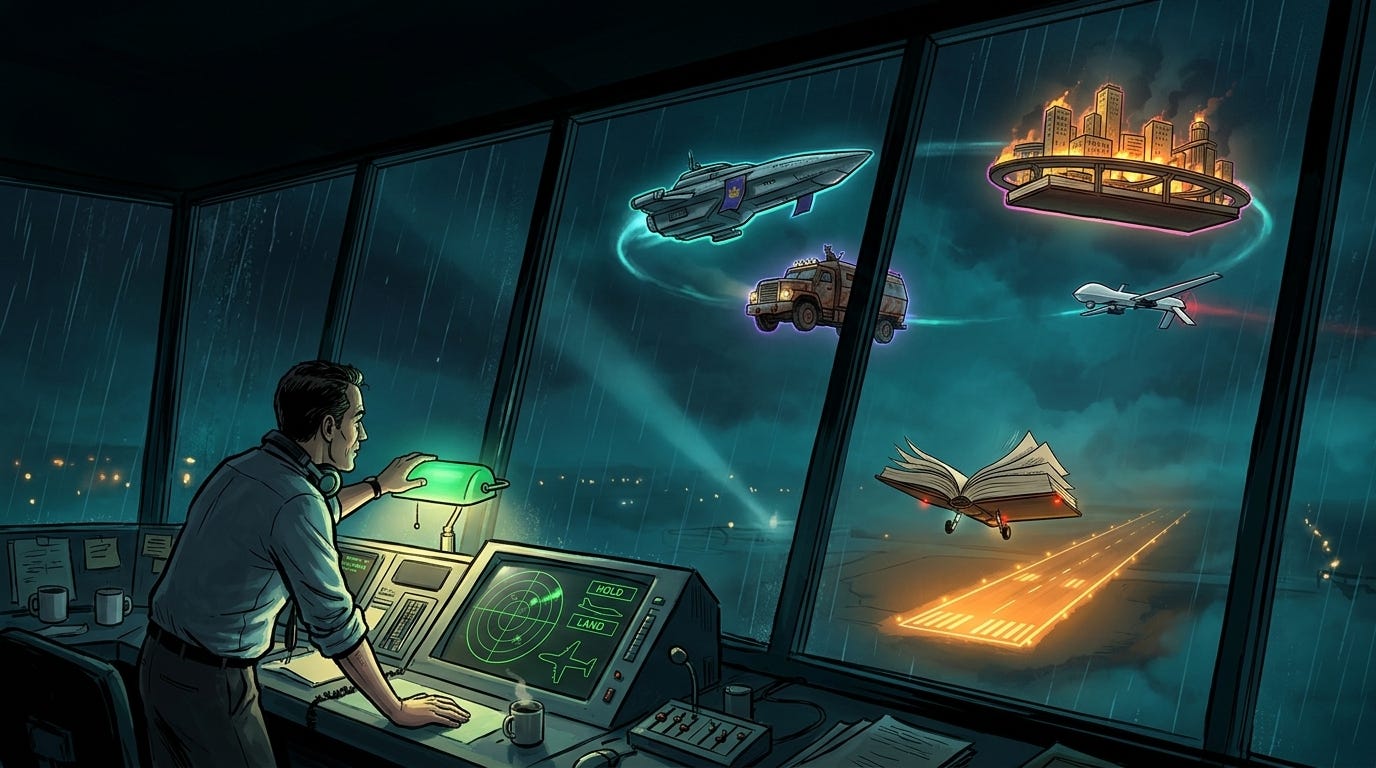
Finish what is closest to earning money, then give the next slot to the idea your current readers will buy without being persuaded. Everything else goes into a one-page file and waits. That is the whole method. The rest of this post is how I apply it when my own head is arguing against it.
Solar Gate is finished. It is Book 7 of The Lightning War, my military science fiction series (eleven if you count the novellas), and I am in the editing pass now.
The week I wrote the last scene, I did not feel relief. I felt four other books pulling at me.
One was Fault Lines, a post-apocalyptic series about an expat family in Austin during a second American civil war. I had already opened a file and written the first chapters. My family and I lived in Austin, I loved the city, and I know the Hill Country terrain well enough that those chapters came without effort.
Another was the third Bastion Chronicles book. That is my zombie apocalypse told by a cat. Two books are out, and I had a concept doc for the third.
The third was The Fox of the Rim, which started in my notes as “The Last Kingdom, but in space.” Fleet politics, a border world, divided loyalty.
The fourth was a near-future dystopia with some of the structure of The Handmaid’s Tale. I wrote a five-page concept doc for it in one sitting.
Each of them felt easier and more exciting than editing chapter 30 of a seventh book. That feeling is the problem.
Why new ideas always win in your head
A new idea has no defects yet. Nothing sags in the middle. No continuity error from three books ago is waiting for you. You get the reward of building a world with none of the cleanup.
Editing is the opposite. You hunt repeated words, fix a timeline, cut a scene you liked. So when a draft is finished, the new idea shows up as a way out. I have learned to read a sudden burst of inspiration in the last week of a draft as a sign that I want to stop editing.
This is not only a problem for people with several pen names. If you publish under one name, it is easier to miss. You tell yourself every book builds the brand. But readers buy a specific promise. A standalone in a neighboring subgenre still needs its own cover research, its own ad keywords and its own readers, and your newsletter list did not sign up for it.
An idea is inventory. Having it does not mean you have to write it next.
