


I still remember staring at a PDF export from Microsoft Word at 11 PM, watching the chapter headers float three millimeters off-center on every other page, somehow, despite the fact that I had not touched them. The book was supposed to go live in four days. I had two more books in the queue behind it.
That was Book 5. I am now on Book 31.
Books 6 through 31 went through Atticus. Every single one of them cleared KDP like a warm knife through butter – no errors, no rejected files, no support tickets, no last-minute panic at midnight. I want to tell you exactly what I think about it, including the part where it falls short, because the hype around it is mostly accurate and the caveats are specific enough that you can decide for yourself in about five minutes.
The Word Problem Nobody Talks About Honestly
Formatting a novel in Microsoft Word is not hard, technically. You set your styles, you manage your margins, you pray to whatever deity handles widows and orphans, and eventually you export something that looks like a book. Most of the time.
The problem is the time tax. Every book you format in Word from scratch is another four to eight hours of fighting styles, rebuilding headers, chasing that one stubborn page break that refuses to die. Multiply that by 30 books across three pen names. Do the math. I’ll wait.
I was spending the equivalent of a full work week per year just on formatting. Not writing. Not marketing. Formatting.
That’s not a creative problem. It’s a systems problem. And systems problems have solutions.
What Atticus Actually Is
Atticus is a browser-based book formatting and writing application built specifically for indie authors. It was created by Dave Chesson, the same person behind Kindlepreneur and Publisher Rocket, which means it was built by someone who understands how KDP actually works, not how software engineers think it works.
The short version: you paste or import your manuscript, choose a theme, adjust a few settings, and export a print-ready PDF and a Kindle-ready EPUB. Both files land correctly on KDP. The table of contents builds itself. The chapter headers are consistent. The margins are pre-set for every standard trim size.
It also does a few things that matter specifically if you’re running a series:
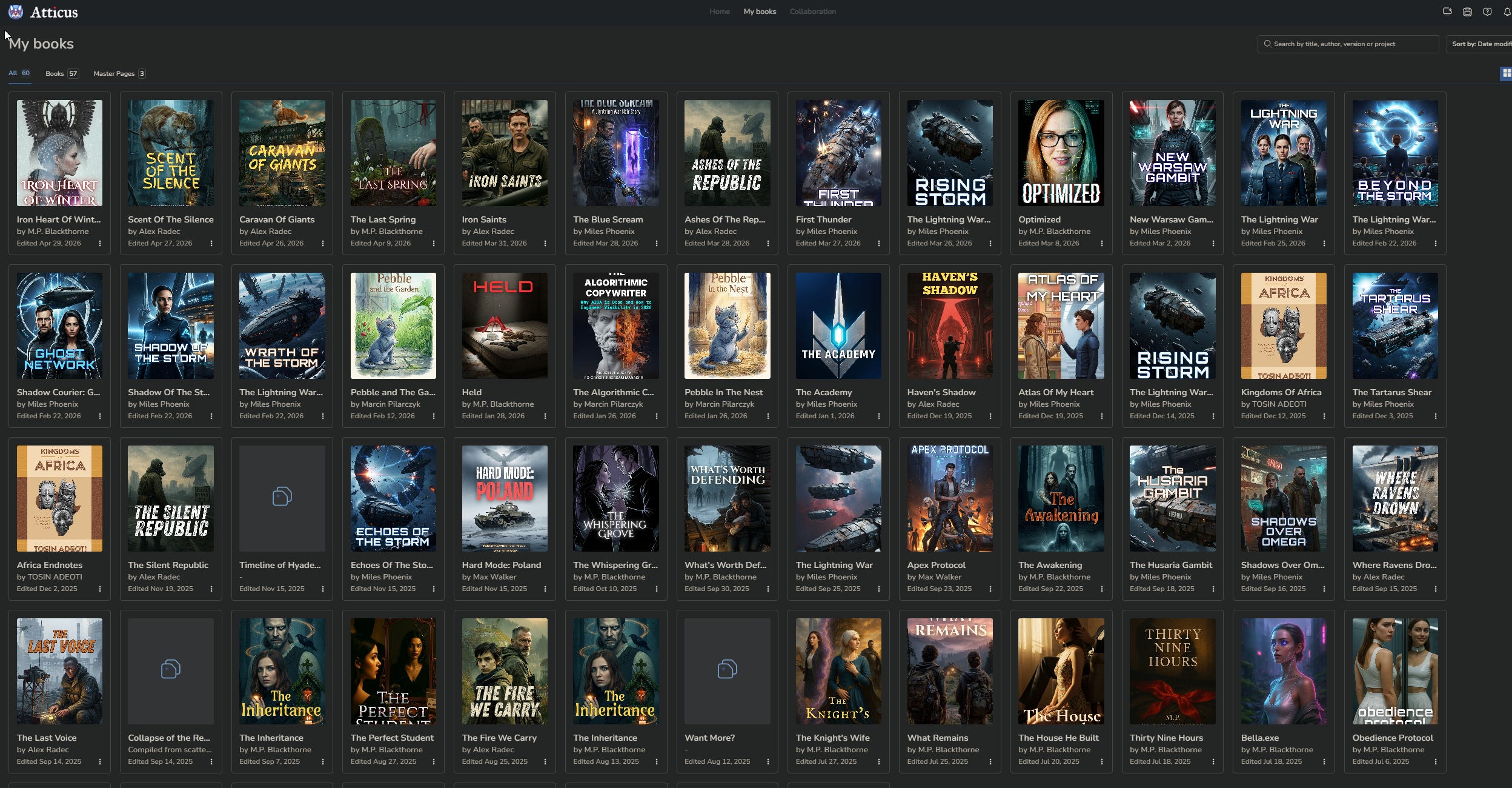
Master Pages. One “Also By” or newsletter sign-up page, updated in one place, pushed to every book in the series simultaneously. When you publish Book 8 and need to update the backlist page in Books 1 through 7, this is the difference between ten minutes and a full afternoon.
Box sets. You can compile multiple existing book projects into a single volume with shared front matter and per-book section headers. The box-set build that used to take me half a day now takes about forty minutes.
Custom themes per pen name. I have a distinct typographic identity for each of my brands – different chapter ornament, different font pairing, different drop-cap style. Built once, applied everywhere inside that pen name’s catalog.
The one-time price is $147. Not per year. Not per pen name. Not per book. Once.
30 Books of Real Data
I am not a reviewer who ran one manuscript through a tool and called it a day. I have formatted novels, novellas, and box sets in Atticus across multiple genres and pen names. I have exported EPUBs for Kindle and PDFs for both KDP paperback and hardcover. Not one file has been rejected. Not one has come back with formatting errors that required a resubmit.
That is a data point. Reviewers who tried one book and found a minor font issue have different data. Mine covers two years and twenty projects.
The workflow I settled on: I draft and edit in my usual environment (my own custom writing studio), then import the cleaned manuscript into Atticus for formatting, make any final interior passes, and export. The whole formatting stage for a standard 90,000-word novel runs about 90 minutes now, including the back matter updates and the final PDF check. That number used to be closer to eight hours in Word.
Where It Doesn’t Belong
I said I’d be honest about the caveats. Here they are.
If you’re writing nonfiction with a lot of annotated images, complex tables, footnote-heavy academic formatting, or anything that looks more like a textbook than a trade book – Atticus will frustrate you. The image handling is functional but not precise. You can’t kern individual lines, you can’t do multi-column layouts, you can’t free-form position a figure caption exactly where you need it. For that work, you want Adobe InDesign.
For most indie fiction authors – military sci-fi, post-apocalyptic, fantasy, romance, thriller, LitRPG – none of that applies. Your book is chapters, scene breaks, and maybe the occasional in-world document formatted as a callout box. Atticus handles all of it without drama.
One other real limitation: it lives in the cloud. If you’re writing on a plane with no Wi-Fi, or in a cabin with spotty connection, the app will behave badly. I don’t draft inside Atticus, so this has never cost me anything, but it’s worth knowing before you commit.
The $147 Argument
Vellum, the Mac-only alternative that many authors cite as the gold standard, costs $249.99 for the ebook-plus-print package. It’s also exclusively for Mac users – if you’re on Windows or Linux, it simply doesn’t exist as an option without workarounds that cost time and money.
Atticus is $147, once, on every platform, for unlimited books. The break-even point against a professional formatter (who charges roughly $200–500 per book for interior design) is the second book you format yourself. Everything after that is margin.
After 30 books, I’ve spent an effective $7.35 per title on formatting. The professional formatter I used for Books 1 through 3, before I knew what I was doing, charged me €180 per title.
I am not going back.
The Honest Summary
Atticus is not perfect software. It has occasional sync quirks, it’s not the right tool for image-heavy nonfiction, and the writing environment inside it – while serviceable – won’t replace Scrivener for serious project management. If you’re a Mac user who only ever publishes ebooks and you want the most polished, zero-friction experience money can buy, Vellum is still a defensible choice.
But if you publish fiction, if you’re on Windows, if you run multiple pen names, if you publish series with backlist pages that need updating every time a new book drops – Atticus is the right tool. Not because the reviews say so. Because I’ve run 30 books through it and none of them bounced.
The best $147 I’ve spent in publishing. After buying back my sanity from Microsoft Word.
Get Atticus here – and if formatting has been the thing standing between your manuscript and the publish button, it won’t be for much longer.
Disclosure: The link above is an affiliate link. If you buy Atticus through it, I earn a small commission at no extra cost to you. I’ve used this tool for two years and 30 books before mentioning it here – that’s the only endorsement policy I run.
I ran Vellum on a Mac-in-Cloud account for a year before I invested in a Mac Mini. I tried Atticus but it never felt right. It's Vellum all the way for me. So brilliant to use for formatting, although I use word for writing with the ProWritingAid add on there.
The one thing that's holding me back from Atticus is the inability to use my own fonts. At the beginning of my publishing journey, I decided to make my headers match the title font, and I'm irrationally sad at the thought of giving that up. (Also, I've purchased a lot of fonts over the years, and I want the ability to do what I want with them.)
One thing that makes me more or less content with Word, though, is that I always use my previous book as a template, so I don't have to go back in and re-set everything every time. 😉 Hasn't failed me so far--here's hoping!