


I’m not a stranger to success. I’ve had books hit the charts and pay the bills.
But I’ve also had books that launched to total, deafening silence.
For a long time, I couldn’t explain the gap. I assumed my successful books were just “better” or that I’d gotten lucky with the timing. I was digging through data, trying to figure out why one of my less successful titles was flatlining, when I finally stumbled onto the missing piece: the invisible world of newsletter promo sites.
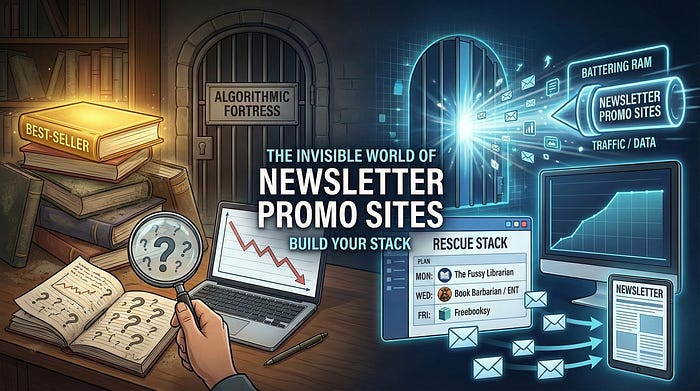
If you’re relying on your “good” books to carry your “quiet” ones, you’re playing a dangerous game of chance. I eventually realized that the digital bookshelf isn’t a meritocracy; it’s an algorithmic fortress. If you don’t show up with a battering ram, the gates stay shut.
That battering ram? It’s a network of promo sites that turned my guesswork into an actual, repeatable strategy.
The Myth of “Organic” Discovery
We like to think that if a book is good, it will eventually find its audience. In 2025, that is mathematically impossible.
Amazon’s algorithm runs on sales velocity. It wants to see a lot of people buying your book in a very short window. This signals that your book is “trending,” which triggers the recommendation engine. Without an initial blast of traffic, you have no velocity. Without velocity, you have no visibility.
Promo sites are the shortcut. They aren’t just ads; they are pre-vetted lists of thousands of readers who are literally waiting for an email to tell them what to buy today.
The “Big Three” Hierarchy
Not all promo sites are created equal. In fact, some are outright scams. Here is how the ecosystem actually looks:
1. The Kingmakers (BookBub & Freebooksy)
BookBub is the undisputed heavy hitter. It’s hard to get in – their editors reject about 80% of applicants – but if you get a “Featured Deal,” you can move thousands of copies in hours. Freebooksy is its counterpart for free books. If you’re giving away the first book in a series to hook readers, this is your primary weapon.
2. The Reliable Pillars (ENT & The Fussy Librarian)
If BookBub is the lottery, Ereader News Today (ENT) and The Fussy Librarian are your bread and butter.
The Fussy Librarian is often the unsung hero for authors on a budget. While other sites charge $100+, you can often snag a slot here for as little as $15 to $22. It’s the perfect low-risk entry point to test if a struggling book’s cover and blurb are actually converting.
3. The Niche Snipers (Book Barbarian & Red Feather)
This is where I finally saw my breakthrough when trying to save my struggling titles.
Book Barbarian: If you write Mil Sci-Fi or high fantasy, this is your gold standard.
Red Feather Romance: Essential for Romantasy. They let you tag the “heat level,” which is critical for making sure the right readers find your book.
The “Stacking” Secret
The biggest mistake I made – even with my successful books – was booking one site and hoping for the best. Pros don’t do that. They stack.
Rank decay is real. If you have 200 sales on Monday and zero on Tuesday, your rank will tank. Stacking involves scheduling 4–5 different sites over a single week to create a “plateau” rather than a single spike.
A typical “Rescue Stack” for a quiet book might look like this:
Monday: The Fussy Librarian (Low cost, starts the momentum).
Wednesday: Book Barbarian or ENT (The mid-tier boost).
Friday: Freebooksy or Bargain Booksy (The volume hammer).
This sustained activity proves to Amazon that your book’s popularity isn’t a fluke.
The “Scam” Warning
A quick word of advice from someone who has wasted money: stay away from Books Butterfly. There’s a lot of noise in the author community about their lack of transparency and “guaranteed” results that never materialize. Stick to the vetted names. Your marketing budget is too small to gamble on black-box operations.
Final Thoughts: It’s Not Just About Sales
The first time I ran a promo stack to rescue a low-seller, I actually lost money on the day of the promotion. I spent $150 and made $90 in royalties. I thought I’d failed again.
Then, the “tail” kicked in.
The rank spike led to thousands of page reads in Kindle Unlimited. Those readers then bought Book 2. By the end of the month, that $150 investment had returned $400.
You aren’t buying sales; you’re buying data. You’re teaching the algorithm exactly who your reader is. Once Amazon knows who likes your book, it starts doing the marketing for you.
Stop waiting for your next “accidental” best-seller. Build your stack instead.
This is an awesome article! Can’t believe I just stumbled into this only now.