


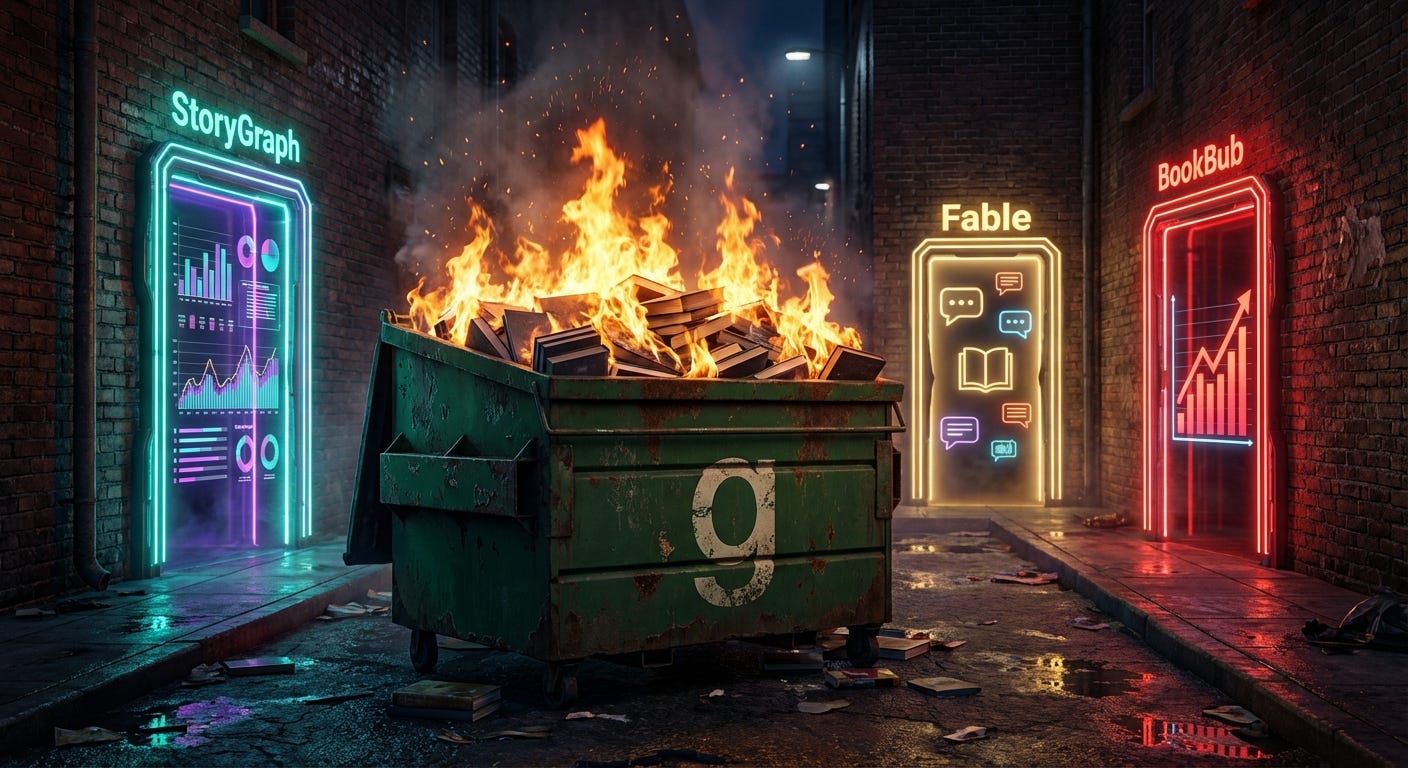
You’ve been playing by their rules for twenty years. It’s a losing game.
Back in 2006, Goodreads felt like a digital library. In 2026, it’s a liability. We’ve all seen it: a 4.2 rating turns into a 3.9 overnight because a group of “sockpuppet” trolls decided they didn’t like your cover or your politics. Amazon watches the fire burn and does exactly nothing, even as their own algorithms bury your book because of those fake reviews.
Stop treating Goodreads like your home. It isn’t. It’s a silent billboard. Claim the profile for the SEO juice, then walk away. Move your actual work to the platforms that don’t treat authors like target practice.
1. StoryGraph: The “Vibe” Machine
If Goodreads is a popularity contest, StoryGraph is a matchmaker. It doesn’t care about “hype.” It cares about data. Specifically, it cares about how a book feels.
With 4 million users now, StoryGraph is the first platform that actually rewards indie authors for writing something specific. It doesn’t ask if a book is “good.” It asks if it’s dark. Or hopeful. Is the pace breakneck or leisurely?
This is a massive win for indies. You don’t need ten thousand reviews to trend here. If a reader wants a “medium-paced, character-driven mystery,” the algorithm will hand them your book because you tagged it correctly – not because you have a massive marketing budget.
The Move
Stop asking your ARC readers for “honest reviews” on Goodreads. Ask them to fill out the “Mood” and “Pace” prompts on StoryGraph. You want to feed that machine-learning engine. That’s how you get found by the right people, not just the loud ones.
2. Fable: The End of the “Lone Reader”
The “social” part of Goodreads has been dead for a decade. Fable brought it back. It’s built on the idea that books are meant to be dissected, not just rated.
Through their partnership with Draft2Digital, you can sell your work directly in their store. But the real gold is the book clubs. You can host a club, invite your fans, and watch them react to your book in real-time.
They leave emojis inside the text. They highlight your best lines. Fable then hands that data back to you through D2D. You can see exactly which sentence made them cry or which plot twist made them angry. That isn’t just “feedback” – it’s your marketing copy for the next three years.
The Move
Launch a “Pub Day Club.” Don’t just post about your release; lead a group through it. Share the backstories you cut from the final draft. Build a fan base that values the conversation more than a star rating.
3. BookBub: The Heavy Artillery
StoryGraph is for discovery. Fable is for fans. BookBub is for cold, hard sales. It remains the most effective way to move 10,000 copies in a weekend.
Forget the “Featured Deals” for a second – they’re hard to get. The real power is in the “Ultra-Narrow” ads. Don’t target a whole genre. That’s a waste of money. Target the followers of three specific authors who write exactly like you.
I’ve seen authors hit a 14% click-through rate just by targeting one specific niche author. It’s precise. It’s fast. And unlike Meta or TikTok, every person seeing your ad is a confirmed book buyer with their wallet already out.
The Move
Stop trying to reach “everyone.” Use BookBub to find the 500 people who worship your specific sub-genre. Run small, $5-a-day tests until you find the “magic” target author, then scale.
The 2026 Strategy
Goodreads is a utility, not a community.
Claim your BookBub and Goodreads profiles to secure your metadata. Lock the doors. Then, stop checking the forums. Don’t reply to the 1-star reviews. Don’t engage with the trolls.
Shift your ARC instructions to StoryGraph. Launch your community on Fable. Use BookBub to drive the revenue.
The “Screw Goodreads” movement isn’t about being angry. It’s about taking your career back from an algorithm that doesn’t care if you succeed. In 2026, the most successful authors are the ones who are the hardest to find on the “big” platforms – because they’re too busy talking to their actual readers somewhere else.
Have you made the jump yet? Or are you still checking your Goodreads notifications every hour? Let’s talk about the exit strategy in the comments.
I HATE Goodreads with a passion. It's old, clunky, and rarely works the way it's supposed to...ugh. Giveaways are good if you can actually get them to allow you to sign up for one. It's much more difficult now.
Thank you for the info, Marcin! I've dipped my toe into BookBub ads... learning.
Goodreads' deterioration becomes more evident every year. Operating essentially as a marketing arm for Amazon, its algorithms are engineered for commercial manipulation rather than genuine curation. However, the true failure lies in the Choice Awards. The platform's transparently ideological bias overtakes the selection process, disproportionately filling the vast majority of nominations with female and LGBTQ+ authors. It is a display of profound intellectual dishonesty.