


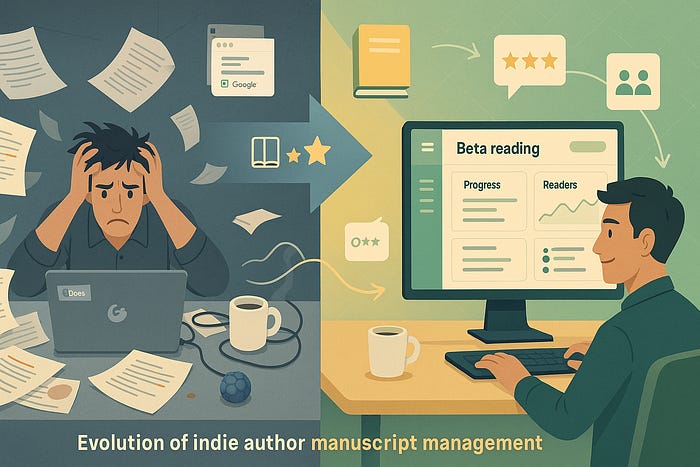
As an indie author, you’re wearing multiple hats: writer, editor, marketer, and project manager. Two of your most critical tasks – gathering meaningful feedback before publication and securing early reviews – can make or break your book’s success. Yet many authors struggle with outdated methods like scattered Google Docs or unreliable community exchanges.
The good news? A new generation of specialized platforms is revolutionizing how indie authors manage beta readers and distribute advance review copies (ARCs). After analyzing dozens of tools and hundreds of user experiences, here’s your complete guide to streamlining these essential processes.
The Evolution Beyond Google Docs
Most authors start their feedback journey with Google Docs – and for good reason. It’s free, familiar, and allows inline comments. But as your reader base grows, the hidden costs become apparent:
Time drain: Consolidating feedback from multiple documents becomes overwhelming
Security risks: Manuscripts can be easily downloaded or shared without permission
Feedback contamination: When all readers see each other’s comments, later reviewers are influenced by earlier opinions
Management chaos: Tracking who’s read what becomes a full-time job
“While Google Docs costs nothing upfront, the manual effort required for feedback management can be substantial,” notes one comprehensive platform analysis. “Authors frequently report spending excessive time organizing and filtering comments, diverting valuable creative energy away from writing.”
The Two-Phase Strategy: Beta Reading vs. ARC Distribution
Before diving into platforms, it’s crucial to understand the distinction between beta reading and ARC distribution:
Beta Reading focuses on manuscript improvement through private feedback on plot, characters, pacing, and overall reader experience. Beta readers help you identify issues before publication.
ARC Distribution aims to generate public reviews and buzz for your published (or soon-to-be-published) book. ARC reviewers help you build social proof and discoverability.
Smart indie authors use different tools for each phase, optimizing their workflow and results.
Dedicated Beta Reading Platforms: Your New Secret Weapon
StoryOrigin: The Engagement Game-Changer
StoryOrigin stands out with its innovative “chapter unlocking” feature – readers must provide feedback on each chapter before accessing the next one. This gamification directly addresses the biggest beta reading frustration: readers who start strong but fade away.
Key Benefits:
Dramatic improvement in completion rates
Integrated marketing tools (newsletter swaps, reader magnets)
Secure, browser-only reading prevents downloads
Free basic plan with robust paid options ($10/month)
Users consistently describe StoryOrigin as a “game-changer” that transforms beta reading from a chaotic process into a streamlined workflow.
Heybeta: Security-First Approach
If manuscript security keeps you awake at night, Heybeta offers peace of mind. Built specifically for indie authors, it prevents downloads while providing detailed progress tracking.
Key Benefits:
Complete security control – revoke access instantly
Private reader lists (not shared with other authors)
Affordable pricing starting at $7/month
Free for readers, reducing participation barriers
BetaBooks: Enterprise-Level Organization
For authors managing large beta teams, BetaBooks offers sophisticated feedback organization tools, including keyword filtering and personalized to-do lists.
Key Benefits:
Advanced feedback sorting and analysis
Reader directory for finding new beta readers
Scales from free (3 readers) to unlimited ($34.99/month)
Eliminates email attachment chaos
BetaReader.io: Analytics-Driven Insights
Beyond standard feedback collection, BetaReader.io provides reading analytics – showing where readers stop, binge-read, or lose interest.
Key Benefits:
Drop-off point analysis reveals problematic sections
Mobile apps for reader convenience
Beta reading swap feature
Simple pricing: free for basic use, $9.99/month for unlimited
The AI Revolution: Instant Developmental Feedback
Artificial intelligence is transforming beta reading by providing immediate, objective analysis that previously required weeks of human feedback.
ProWritingAid Virtual Beta Reader
This AI tool simulates a human reader’s experience, identifying emotional connection points, pacing issues, and memorable moments. It’s explicitly designed as a pre-screening tool – not a replacement for human readers.
Best For: Quick developmental analysis before engaging human beta readers
Authors A.I. Marlowe
Marlowe generates comprehensive 32-page reports in under five minutes, including comparisons to bestselling novels in your genre – bridging editorial critique with market analysis.
Best For: Authors wanting detailed structural analysis plus commercial positioning insights
ARC Distribution: Building Your Review Foundation
Once your manuscript is polished, shifting focus to ARC distribution can make the difference between launching into silence or building momentum.
BookSirens: Quality Over Quantity
BookSirens boasts an impressive 75% review completion rate by carefully monitoring their reader community and restricting access for non-reviewers.
Pricing Model: $10 listing fee + $2 per reader (or $100/year unlimited) Best For: Authors wanting reliable reviews from vetted readers
StoryOrigin: The Multi-Tool Approach
Beyond beta reading, StoryOrigin excels at ARC distribution with automated reminder systems and reviewer tracking.
Best For: Authors wanting to manage both beta reading and ARC distribution from one platform
Hidden Gems: Premium Review Generation
For authors willing to invest significantly in their launch, Hidden Gems delivers high-volume reviews (often 50–100+) from their curated email list.
Investment: $20 deposit + $3 per reader (typically $150–400 total) Best For: Authors treating their launch as a major marketing investment
NetGalley: Industry Gold Standard
While expensive at full price ($450+), NetGalley co-ops make this industry-standard platform accessible to indies for around $50–100.
Best For: Authors seeking librarian, bookseller, and industry professional reviews
Crafting Your Optimal Strategy
The most effective approach combines multiple tools strategically:
Phase 1: Early Development
AI beta reader for rapid structural analysis
Dedicated platform (StoryOrigin/Heybeta) for 5–10 human beta readers
Focus on plot, character development, pacing
Phase 2: Pre-Publication Polish
Second round of beta readers for final feedback
Professional editing based on accumulated insights
Phase 3: ARC Distribution
BookSirens or StoryOrigin for reliable review generation
NetGalley co-op for industry visibility (budget permitting)
Hidden Gems for high-volume review push (for major launches)
Key Success Factors
Regardless of your chosen platforms:
Vet readers carefully – Genre familiarity and demonstrated reliability matter more than enthusiasm
Provide clear instructions – Specific questions yield actionable feedback
Respect reader time – Polish your manuscript before sharing
Manage expectations – Not every suggestion requires implementation
Prioritize security – Choose platforms with robust IP protection
The ROI of Professional Management
While free options exist, dedicated platforms typically pay for themselves through:
Time savings: Hours returned to writing instead of feedback management
Higher completion rates: Better reader engagement and follow-through
Improved feedback quality: Structured collection yields more actionable insights
Peace of mind: Security features protect your intellectual property
Looking Forward
The beta reading and ARC landscape continues evolving rapidly. AI tools are becoming more sophisticated, dedicated platforms are adding innovative features, and the integration between feedback collection and marketing tools is deepening.
For indie authors in 2025, the question isn’t whether to upgrade from basic Google Docs – it’s which combination of modern tools will best serve your specific needs and budget.
The investment in professional beta reading and ARC management isn’t just about convenience – it’s about giving your book the best possible foundation for success. In a marketplace where first impressions matter enormously, the quality of your pre-publication process directly impacts your post-publication results.
Your manuscript deserves readers who are engaged, your feedback deserves to be organized, and your launch deserves professional reviews. The tools exist to make this happen – the question is which ones you’ll choose to transform your publishing workflow.