


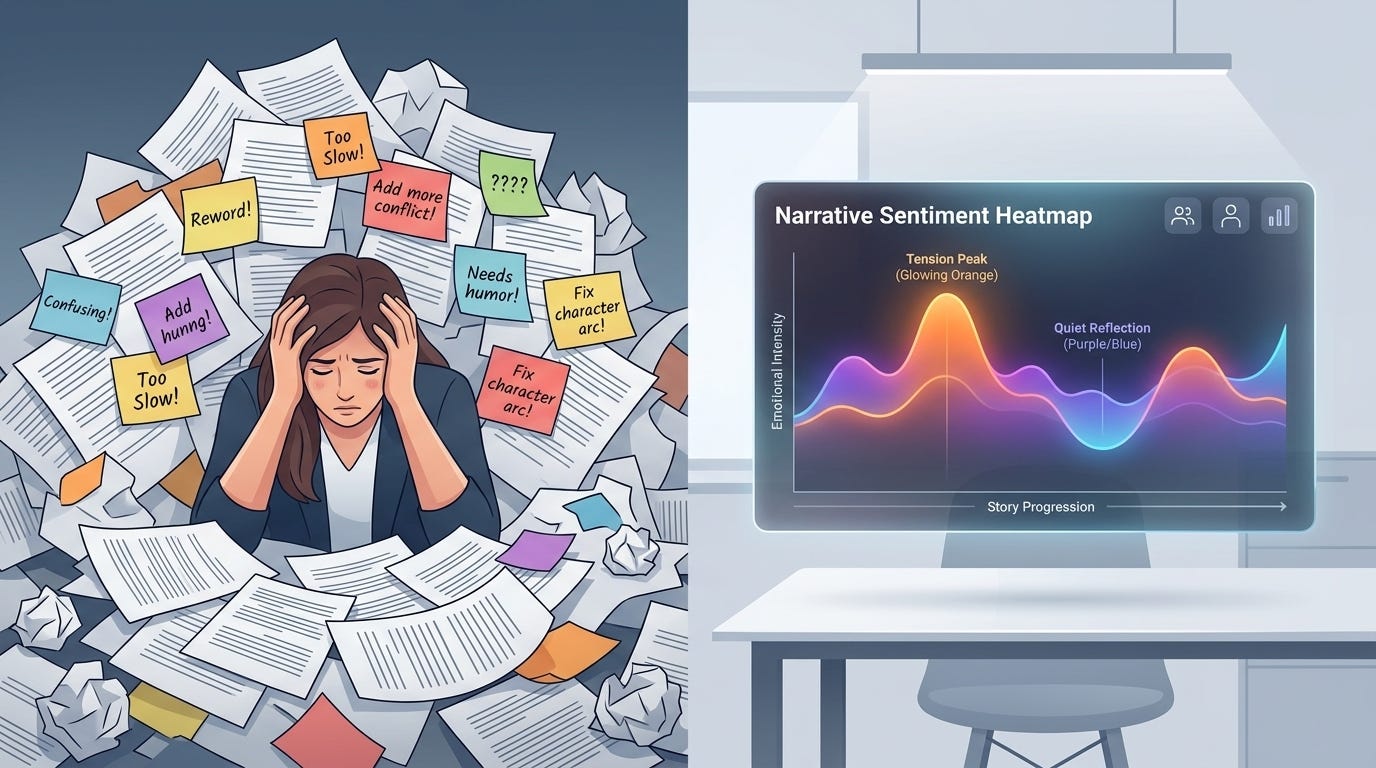
You just got your manuscript back from a large group of beta readers, and your inbox is a warzone of conflicting opinions. Reader A thinks your protagonist is delightfully flawed. Reader B thinks she is completely insufferable. Reader C left a three-page rant about the pacing in chapter four.
How do you decide what to actually change?
If you are relying on manual review, you are likely falling victim to the “loudest voice wins” dysfunction. This cognitive trap occurs when an author over-reacts to a single, highly vocal critic instead of acting on the actual consensus of the reader group. When you are manually reading and trying to synthesize hundreds of comments, your brain naturally anchors to the most extreme emotional reactions. Worse, manual processing of feedback takes weeks or even months, severely bottlenecking your publishing schedule.
By 2026, the high-volume indie author no longer has to rely on gut feelings or messy spreadsheets. The role of artificial intelligence in publishing has evolved far beyond drafting text; its true power lies in synthesizing reader sentiment.
Modern AI sentiment models have achieved an astonishing 85-95% accuracy in detecting emotional intensity, significantly outperforming manual human coding, which typically hovers between 70-80%. These models have transitioned from simple binary classification (is this comment positive or negative?) to multimodal analysis, meaning they can detect the exact intensity level of a reader’s reaction – differentiating between “mild frustration” and “urgent anger” within a single response.
This technology allows authorpreneurs to process massive amounts of feedback in hours or minutes rather than weeks, surfacing statistically significant patterns that are completely invisible in smaller feedback pools.
To implement this data strategy, authors are turning to platforms like authorshaven.io. Instead of handing you a raw list of comments, the platform provides chapter-level sentiment heatmaps. These heatmaps visually color-code the density of reader reactions, allowing you to see at a single glance exactly where your narrative pace drags, where a joke lands perfectly, or where a character’s motivation confuses the audience.
Furthermore, the platform utilizes AI to generate an automated theme summarization. Instead of reacting to that one vocal outlier who hated your plot twist, you are presented with an objective, prioritized revision checklist that reflects the collective experience of your entire audience.
Your creative soul wrote the book, but data should guide the revision. By utilizing sentiment heatmaps and AI analysis, you can bypass the emotional labor of sifting through critiques, eliminate the loudest voices, and refine your narrative with pinpoint precision.