


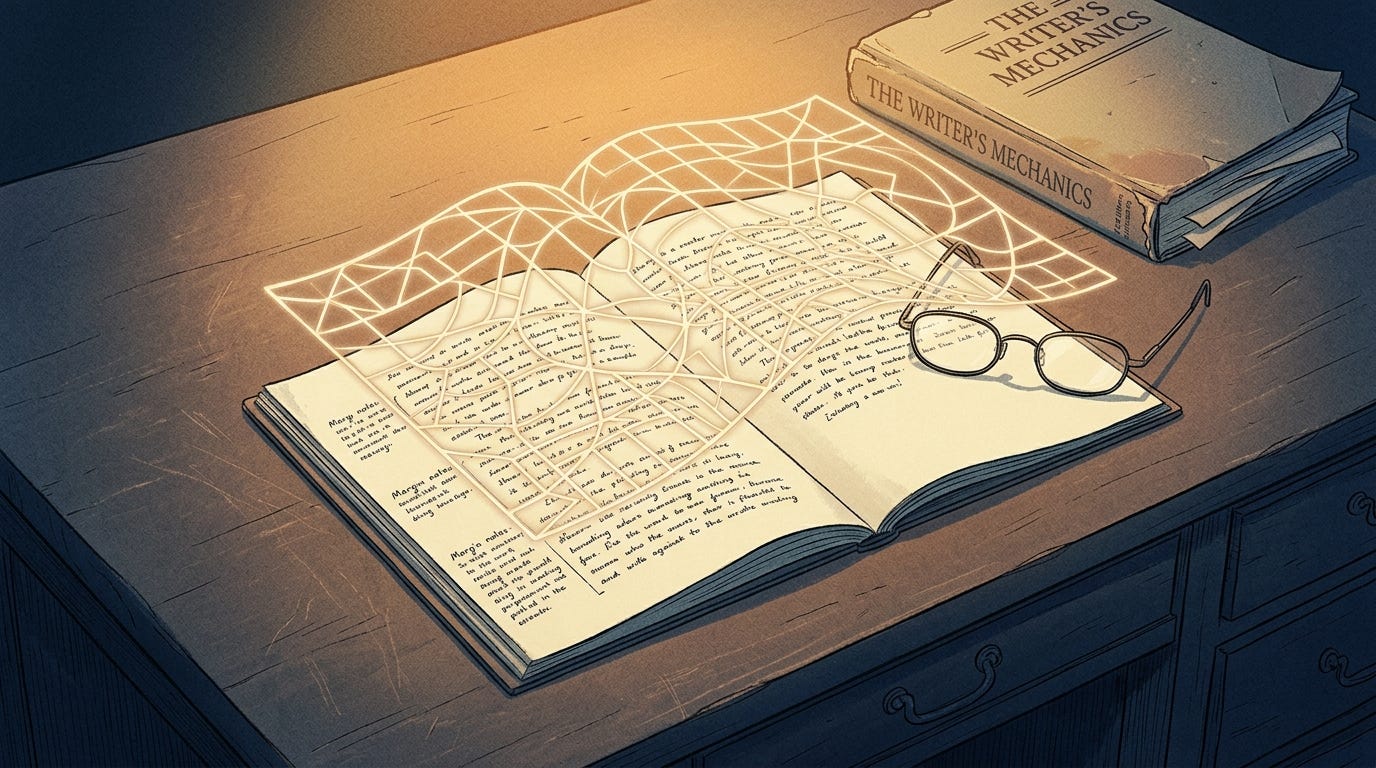
There’s a moment in editing – a good editing session, with a good editor – where someone sees your book more clearly than you can. Not the typos. Not the clunky sentences. The thing underneath. The promise you made the reader on page one that you quietly broke by page two hundred.
I had that moment recently. The editor who caught it wasn’t human.
I want to be precise about what happened, because precision matters here.
I was working on a novel with a central couple – Slavic romance, two characters I’d designed from the start to be equals. No savior. No victim. Each with their own competence, their own agency, their own reason to be in the room. It was important to me thematically. It was the moral spine of the book.
I ran the manuscript through what I call my macro-editing prompt – a system I’d built over months that instructs the AI to evaluate the whole story, not sentences. Structure, character arc, thematic consistency, the moral argument running underneath everything. I fed it a 22-step plot framework, a four-corner opposition model, diagnostic questions about leitmotiv and continuity of tone.
The AI read the whole manuscript in that frame and came back with a note I’d have paid three thousand dollars for a human editor to catch: the equal-agency theme I’d built into the premise wasn’t holding through the second half. In several key scenes, one character was drifting into a reactive role. The balance was off. The promise was quietly breaking.
That’s not copyediting. That’s developmental work. The kind editors charge the most for, the kind authors fear the most, the kind that’s supposed to require a human being with years of experience and genuine literary taste.
I should be honest about what this actually required.
The AI didn’t spontaneously notice the problem. I had to know enough about craft to build a prompt that asked the right questions. The 22-step framework I used comes from John Truby’s work on story structure. The four-corner opposition model, the concept of treating a story as a living body with a moral argument as its brain – these aren’t things I invented. They’re frameworks that serious editors and story theorists have developed over decades.
I encoded them. That’s what I actually did. I took accumulated editorial knowledge, systematized it, and gave the AI a lens precise enough to find what I was looking for.
Most authors couldn’t do this. Not yet. It required understanding developmental editing deeply enough to articulate it, and enough technical comfort to translate it into something a language model could apply.
But here’s the thing: two years ago, even with the right prompt, the AI couldn’t have done what it did. The models weren’t capable of holding a full manuscript in context and tracking a thematic thread across two hundred pages. Now they can. The progress isn’t incremental. It’s a different category of capability.
I’ve sold over 8,000 copies of my books without a human editor. I’m a former tech industry person – laid off from Google, then Marqeta – who came to fiction writing with an engineering mindset and a deep suspicion of processes I couldn’t interrogate. When I looked at what professional editing cost ($2,400 to $5,600 for a full manuscript edit) against what AI editing could do at my stage, I made a deliberate decision.
I’m not saying human editors are obsolete. I’m saying the calculation changed, and it’s still changing.
For indie genre fiction authors operating below a certain revenue threshold, the ROI on human editing no longer makes obvious sense. That’s a specific, bounded claim. I’m not applying it to literary fiction with a genuinely unconventional voice, or to authors chasing traditional publishing deals where relationships and reputation work differently.
But the trajectory matters more than the current snapshot. If AI editing went from inadequate to good enough for serious genre work in two years, where does it go in five? The question of whether AI will one day edit NYT bestsellers isn’t science fiction. It’s a planning horizon.
So what does this mean for editors?
I’ve been thinking about this carefully, because I don’t think the answer is nothing. The editors who survive this won’t be the ones who do what I’ve learned to automate. They’ll be the ones doing what I still can’t.
Taste-making and curation. As AI floods the market with competent content, trusted human judgment about what’s actually good becomes scarcer and more valuable. The A&R model. Editors who build a public reputation for recognizing something real have a durable position.
Author development. Editing a manuscript is different from developing a writer. The longitudinal coaching relationship – tracking someone’s recurring weaknesses across years, understanding their career, not just their current book – is harder to automate because it’s relational and continuous.
Publishing strategy. The best traditional editors always did something beyond manuscript craft. Genre positioning, series architecture, understanding what readers in a specific category actually want this year. That market intelligence combined with editorial judgment is a real and distinct skill.
Framework design. This one is newer and I think underappreciated. Editors who deeply understand craft theory – who can articulate what makes a story work at a structural and moral level – have knowledge that doesn’t become worthless when AI gets good at applying it. It becomes the thing you encode into systems. There’s a version of editorial consulting that looks less like manuscript notes and more like building the tools authors use to interrogate their own work.
The pivot that won’t work is “AI-assisted editing services” – becoming a middleman between authors and tools they’ll learn to use directly. That just delays the problem by a step.
I want to end with the honest version of what I learned from that moment with my AI editor.
The thing it caught – the thematic drift, the broken promise about character agency – it caught it because I’d spent serious time encoding what good developmental editing actually looks for. The AI was the processing power. The editorial intelligence was mine, built from reading widely, studying craft, failing across multiple drafts.
What I’m describing isn’t the death of editorial knowledge. It’s a change in how that knowledge gets used. Instead of being sold per manuscript, it increasingly gets built into systems, shared, distributed.
Whether that’s a crisis or an opportunity probably depends on which side of the desk you’re sitting on, and how early you start thinking about it.
The editors I’d bet on are the ones asking that question now, while they’re still earning well, before the answer becomes urgent.
The 3-pass system I used – Pass 1 for soul and structure, Pass 2 for copyediting, Pass 3 for dead metaphors across the full manuscript – is documented in full for paid subscribers, including the model-switching insight that changed my catch rate. If you’re an Inner Circle member, keep reading.
The Novelist Studio and its soon to be rolled out spinoff StoryTeller.ai is a great AI system to develop your concept, outline the story, and run the draft through the developmental editor.
I’m 100% onboard with AI editing. I’m a debut indie author and I operate on a tight budget. I’ve had to use AI editing because it is what I can afford. I’m using the newest models and it surprises me by the things it points out for me to correct or rewrite.
I’m becoming a firm believer in the usefulness AI editing offers for those willing try it, or those who have no other choice.
Thanks for your post!